
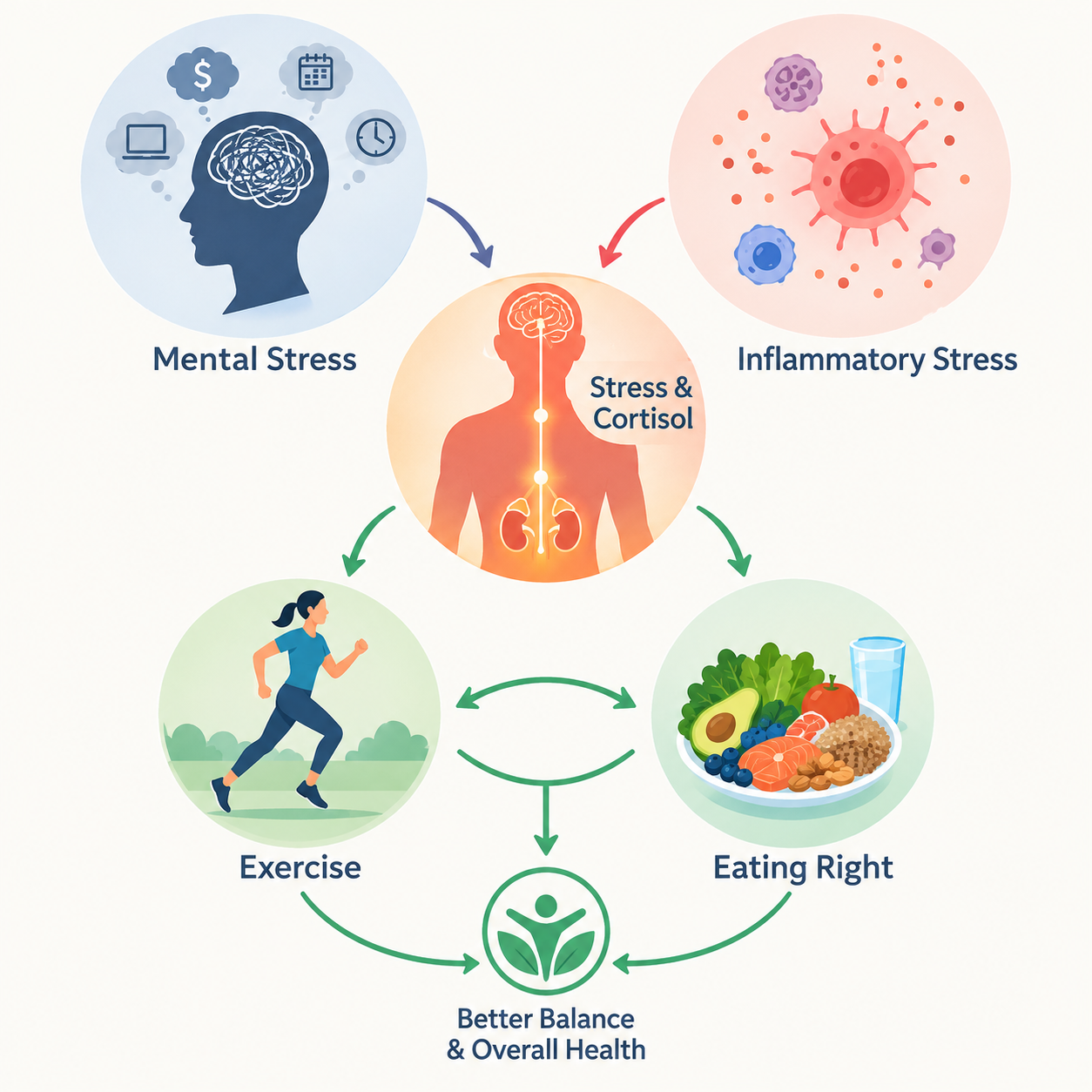
It is hard to understand how mental stress can contribute to chronic sickness, weight gain, weight loss and muscle loss. Yet, look around and you will see how differently it manifests. Some people show it on their face or skin, some through changes in weight, some experience a racing heart and difficulty breathing, while others develop digestive problems or grow weaker despite eating sufficient food.
Our ancestors recognised these signs long before they understood the physiology behind them. Today, advances in science are helping us understand why seemingly unrelated changes can occur together.
I believe understanding this connection can help us appreciate why mental stress is not merely a problem of the mind or sleep. It can affect the functioning of the entire organism.
1. Two kinds of stress, interconnected pathways
Broadly, we can consider psychological stress and physiological stress, including inflammation, infection and tissue injury. Although they begin differently, both can activate overlapping regulatory systems involving the brain, autonomic nervous system and endocrine system.
One important pathway is the hypothalamic–pituitary–adrenal (HPA) axis. When the brain perceives a threat, the hypothalamus releases CRH, stimulating the pituitary to release ACTH. ACTH signals the adrenal glands to release cortisol.
Inflammatory cytokines, such as IL-1β, IL-6 and TNF, can also stimulate this pathway. Conversely, cortisol helps regulate inflammatory activity through glucocorticoid receptors. The relationship works in both directions.
2. What does cortisol actually do?
Cortisol is not simply a stress hormone. It helps regulate glucose availability, blood pressure, metabolism and immune activity. It prepares the organism to meet immediate demands and helps regulate the response to challenges.
In the short term, these responses are adaptive. However, prolonged stress can disrupt metabolic regulation, sleep, immune function and muscle maintenance. Chronic stress does not always mean continuously elevated cortisol; the pattern of hormonal regulation itself can change.
The important point is that stress can affect several interconnected systems simultaneously.
3. Can we counter the effects of stress?
Simply telling someone, “Don’t take stress,” doesn’t work. We all understand that stress is undesirable, but understanding a problem doesn’t necessarily give us the means to control it.
Perhaps the objective should be to counter its physiological effects and support the body’s ability to regulate itself, maintain its functions and recover.
Considering stress changes how our energy flows and is distributed. How about handling it smartly – both the availability & burn.
Two things immediately come to mind: exercise and eating right—not eating less.
Exercise: Changing the organism’s response
Exercise offers two interesting ways to counter the effects of stress.
First, it shifts the mind’s focus. When we engage in demanding exercise, our attention is drawn towards the task at hand. While lifting a heavy weight or running out of breath, we are less likely to be preoccupied with our finances, work or other sources of psychological stress. Exercise can interrupt repetitive thinking and, over time, improve our ability to regulate stress responses.
Second, it changes the body’s physiological demands. Working muscles require greater blood flow, fuel delivery and subsequent repair. Muscle contractions stimulate glucose uptake through pathways that do not depend entirely on insulin, while regular exercise improves insulin sensitivity.
The immune system also participates in the repair and remodelling that follow exercise. The organism is responding to a different set of demands, engaging its muscular, metabolic, cardiovascular and immune systems in a coordinated response.
Exercise does not simply switch off inflammation or transfer the immune system from one task to another. Rather, it can improve the organism’s capacity to manage demands and recover, provided the exercise is appropriate and recovery is adequate.
Eating right: Beyond carbohydrates, proteins and fats
Nutrition is equally important, but I believe we often approach it from the wrong direction. We tend to look at food primarily through its macronutrients: carbohydrates, proteins and fats.
These matter, but the body’s requirements are not identical at every moment. Activity, recovery, metabolic state and the timing of food influence how nutrients are handled.
For example, eating fruit before or after exercise can produce a different metabolic response from eating the same fruit during prolonged inactivity. Muscle contractions stimulate glucose uptake independently of insulin, and exercise can improve insulin sensitivity for hours afterwards.
This does not mean that fruit is beneficial only around exercise. It means that the physiological context in which we eat matters.
Perhaps instead of looking only at what is on our platter, we should also consider what the organism needs at a given point in time. The objective is not necessarily to eat less, but to eat appropriately to support activity, maintenance and repair.
4. Where does the Balance Theory come into play?
The Balance Theory, by itself, does not provide a ready-made solution. Its value lies in helping us understand why a solution is necessary in the first place.
When we appreciate how prolonged psychological stress can disrupt metabolic processes, hormonal pathways and coordination between different systems, we begin to recognise the importance of restoring balance to the organism.
The question shifts from simply asking how to eliminate stress to asking how we can help the organism manage its effects and recover its ability to regulate itself.
Exercise and appropriate nutrition are two ways to support this process. They influence multiple systems rather than targeting a single symptom.
The Balance Theory does not prescribe a single solution. It provides a reason to look for one. It encourages us to understand the demands placed on the organism, the consequences of prolonged imbalance and the means through which we may help restore its capacity to maintain and repair itself.
P.S. The general advice to exercise is sound. However, in this specific context, I believe there is a case for hard effort, not merely movement. A sufficiently demanding exercise session can shift attention away from persistent mental stress and trigger an acute physiological response that the body is equipped to manage and recover from. In a way, we are introducing a controlled, short-lived stressor to help the organism respond differently to an ongoing one.
The idea is not to add more stress indiscriminately, but to use a manageable, recoverable stress to challenge the system and support its capacity to adapt.
Sometimes, to counter stress, we may need to introduce the right kind of stress.

