
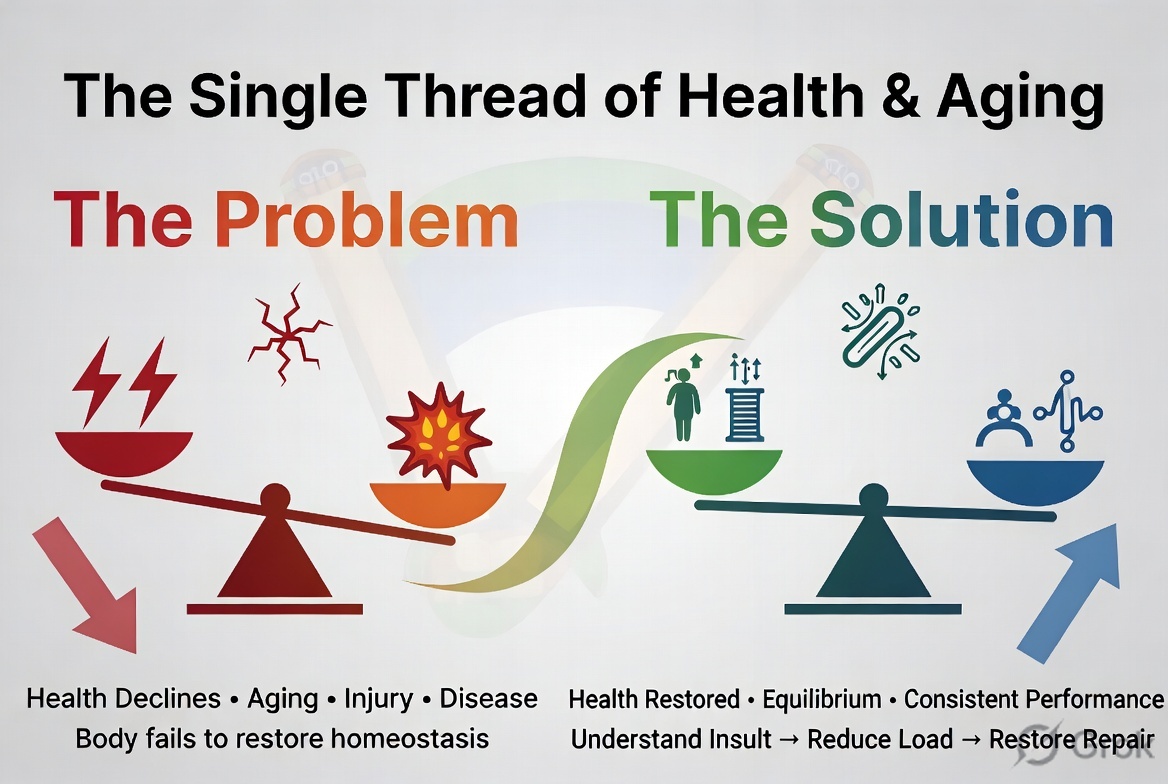
What if I told you that the root of ill health and aging is surprisingly simple? It comes down to our body’s innate failure to keep up with the daily task of staying healthy when the insults of living outpace our natural capacity to clear, repair, and restore balance. The good news is that the solution is equally straightforward: by intelligently understanding and reducing the load on the affected system, we create the conditions for equilibrium to return between damage and repair.
When Repair Falls Behind: The Single Thread Running Through All Disease and Aging
(Repair: The body’s capacity to detect damage, remove dysfunction, and restore function across all biological systems.)
Health is not the absence of damage. It is the continuous, successful restoration of balance after damage occurs.
Every day, the body faces insults across the systems – mechanical, metabolic, chemical, emotional, and neural. These are not optional. Living itself generates them. What separates a resilient system from one that begins to deteriorate is not the presence or absence of these insults. It is whether the body’s inherent clearance and repair mechanisms can keep pace with them.
When they cannot, accumulation begins. And accumulation, left unchecked, becomes the seed of every recognizable form of decline whether we label it disease or aging.
The Brain
In the brain, microglia are meant to detect and clear damaged neurons, misfolded proteins, and metabolic debris on an ongoing basis. When this clearance capacity is outstripped, the material that should have been removed stays. What follows is not the primary problem, it is the consequence. Chronic low-grade inflammation, oxidative stress, and eventually the visible deposits associated with neurodegeneration appear because the daily housekeeping failed. The brain, being the master regulator, does not suffer in isolation. Its failure to maintain internal order sends ripples through every system it governs.
The Vascular System
Arteries are not static pipes. They are living tissue under constant mechanical and chemical stress. The body has mechanisms to repair the endothelium and clear early lipid accumulations. Small plaques can be managed and even bypassed through natural collateral development. But when clearance and repair cannot match the daily load, net accumulation occurs. The plaque that eventually narrows an artery is not the starting point of the problem. It is evidence that the repair-and-clearance system has already been falling behind for a long time.
Metabolism
Muscle, liver, pancreas, and kidneys are all participants in the continuous work of handling fuel and waste. When glucose uptake and clearance cannot keep up with incoming load, blood glucose remains elevated. Insulin rises in an attempt to force clearance. Over time, the system that was designed to maintain tight control begins to tolerate higher set-points. Fatty liver, elevated triglycerides, and downstream organ stress are not independent diseases. They are the visible results of a clearance capacity that has been exceeded.
The Musculoskeletal System
Training, posture, daily movement – all create mechanical insults. A healthy system responds with repair and adaptation. When recovery capacity is insufficient, small irritations do not resolve. They compound. What begins as a niggle becomes an injury not because the load was inherently destructive, but because the repair processes could no longer match the rate of insult. Conversely, when stimulus is too low, the system also loses integrity through underuse. In both cases, the failure is the same: homeostasis is not being actively restored.
Cancer, Senescence, Cells
At the cellular level, damaged and senescent cells are continuously produced. The body has surveillance and clearance mechanisms – immune recognition, apoptosis, autophagy, to remove them before they become problematic. When these clearance processes fall behind, non-functional cells persist and can eventually organize into self-sustaining structures. From an evolutionary perspective, senescence appears to have evolved as a short-term protective mechanism.
Cancer, in this view, is not a mysterious external invader. It is what happens when the body’s ongoing work of identifying and removing compromised cells is no longer keeping up.
The Central Thread
Look across any system and the pattern is identical. Health declines when the rate of insult exceeds the rate of successful repair and clearance. The body does not ‘decide’ to become sick. It simply reaches a point where it can no longer finish the daily work of returning to equilibrium.
This is why the brain-body relationship is so decisive. The autonomic nervous system’s ability to move fluidly between mobilization (SNS) and restoration (PNS) is not merely about feeling calm or stressed. It is about whether the regulatory signals that govern immune activity, vascular repair, metabolic handling, and tissue recovery are being delivered effectively. When the brain can no longer orchestrate this back-and-forth with precision, every downstream system loses its adaptive margin.
Aging and disease, in this light, are not separate categories. They are different expressions of the same underlying reality: the gradual (or sometimes sudden) widening of the gap between the insults life delivers and the body’s capacity to clear and repair them.
The question is no longer which disease or which aging process we are looking at. The only meaningful question becomes: Where, and why, has the clearance and restoration capacity fallen behind?
That single lens explains the surface diversity of symptoms while pointing to the common mechanism underneath.
The Way Back/SOLUTION: Reduce the Load, Restore Repair Capacity
The solution is as direct as the problem: Understand the specific insult, then intelligently reduce the load on that system, sometimes by applying the right kind of load so that the body regains the time and space it needs to clear, repair, and return to homeostasis.
This is not about avoiding all stress or chasing extreme interventions. It is about creating a temporary or ongoing window where repair capacity can once again match or exceed the insults.
Brain When the brain lives in chronic SNS dominance, the immune system’s daily clearance work becomes harder. By restoring harmony between SNS and PNS through simple practices such as mindfulness, meditation, breath work, or gratitude, the regulatory load decreases. The brain’s immune cells can then perform their housekeeping role more effectively, reducing the background inflammation that arises from unfinished repair.
Heart and Vascular System The real burden is not primarily cholesterol but the load of poorly functioning vascular machinery. Reduce this by lowering excess calorie intake, improving heart rate variability through appropriate exercise, and using breath work to create better flow and shear stress in the arteries. As the machinery begins to work more efficiently, the effective plaque burden on the system naturally eases, giving repair mechanisms room to operate.
Metabolic Machinery Chronic fuel overload overwhelms clearance pathways. Strategic fasting, calorie restriction when needed, and increasing non-exercise activity (NEAT) reduce the incoming load. This gives the muscle, liver, pancreas, and kidneys the opportunity to reset sensitivity and restore efficient waste and nutrient handling.
Musculoskeletal System Mechanical insults are highly individual. Reduce load by listening closely: stretch tight fascia, rest overworked muscles, unload stressed joints, and introduce light movement or targeted strength work where weakness is pulling the system out of balance. The body is given precisely what it requires — nothing more, nothing less so recovery can complete instead of being perpetually interrupted.
True health, then, is not a destination reached by fighting symptoms or chasing single pathways. It is the quiet, daily victory of keeping repair capacity ahead of the insults life naturally delivers. By learning to see the specific load on each system and intelligently reducing it whether through rest, the right movement, breath, fasting, or inner harmony we give the body what it has always asked for: the chance to finish its work. In the end, the body already knows how to heal. Our role is to stop overwhelming the systems that make healing possible.

