
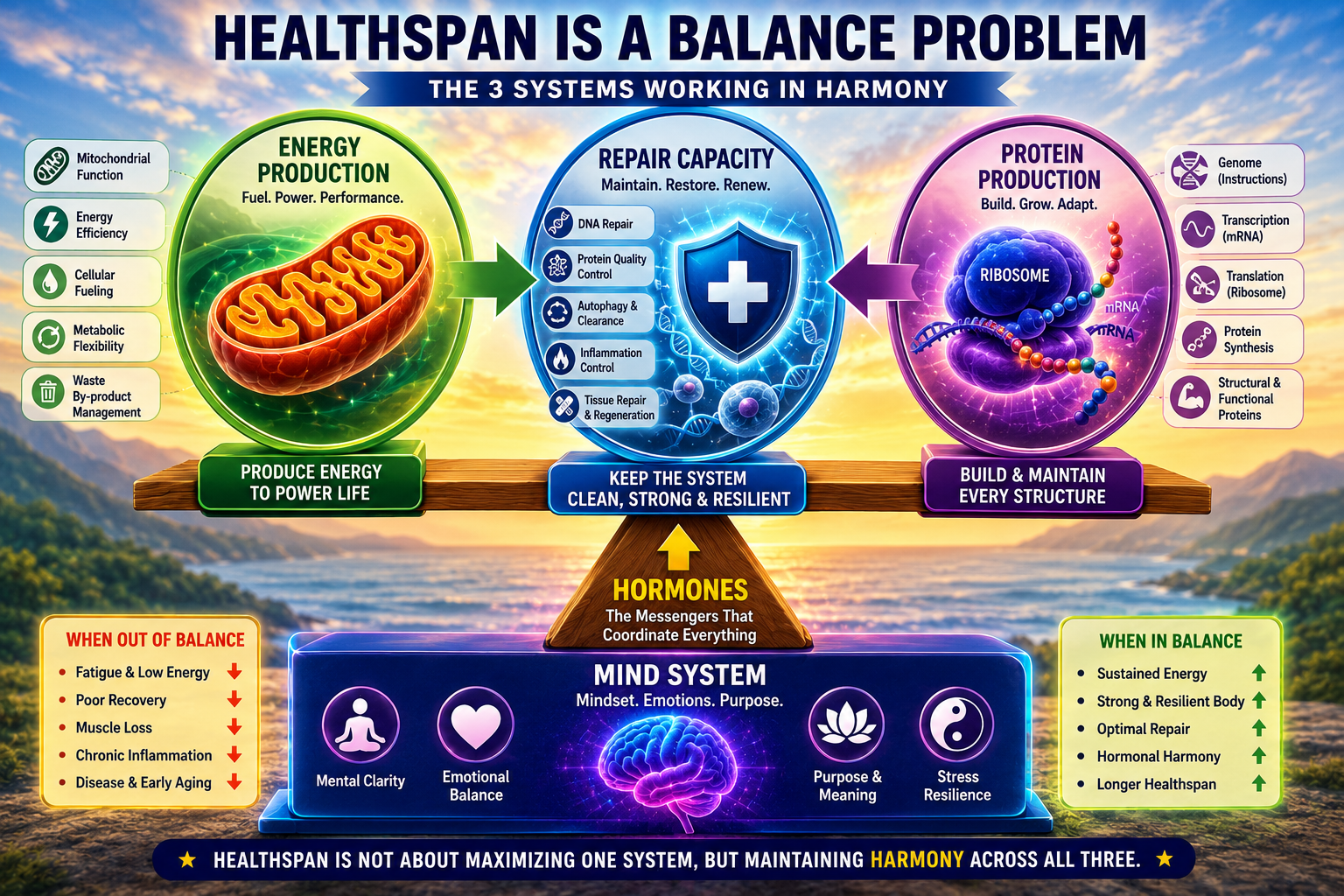
My proposed Balance Theory:
Healthspan Is a Balance Problem
For decades, discussions around health and longevity have revolved around individual pathways. Some focus on muscle and protein synthesis. Others focus on mitochondria and energy production. More recently, autophagy or DNA repair has become the darling of the longevity world.
But what if we are looking at the problem incorrectly or only from one angle?
What if healthspan is not determined by maximizing a single pathway, but by balancing several pathways that are fundamentally dependent on one another?
This idea forms the basis of my Balance Theory.
Before explaining the theory, we need to understand the three major cellular systems that govern life, as I have come to understand them through the work of several scientists.
The Three Systems of the Cell
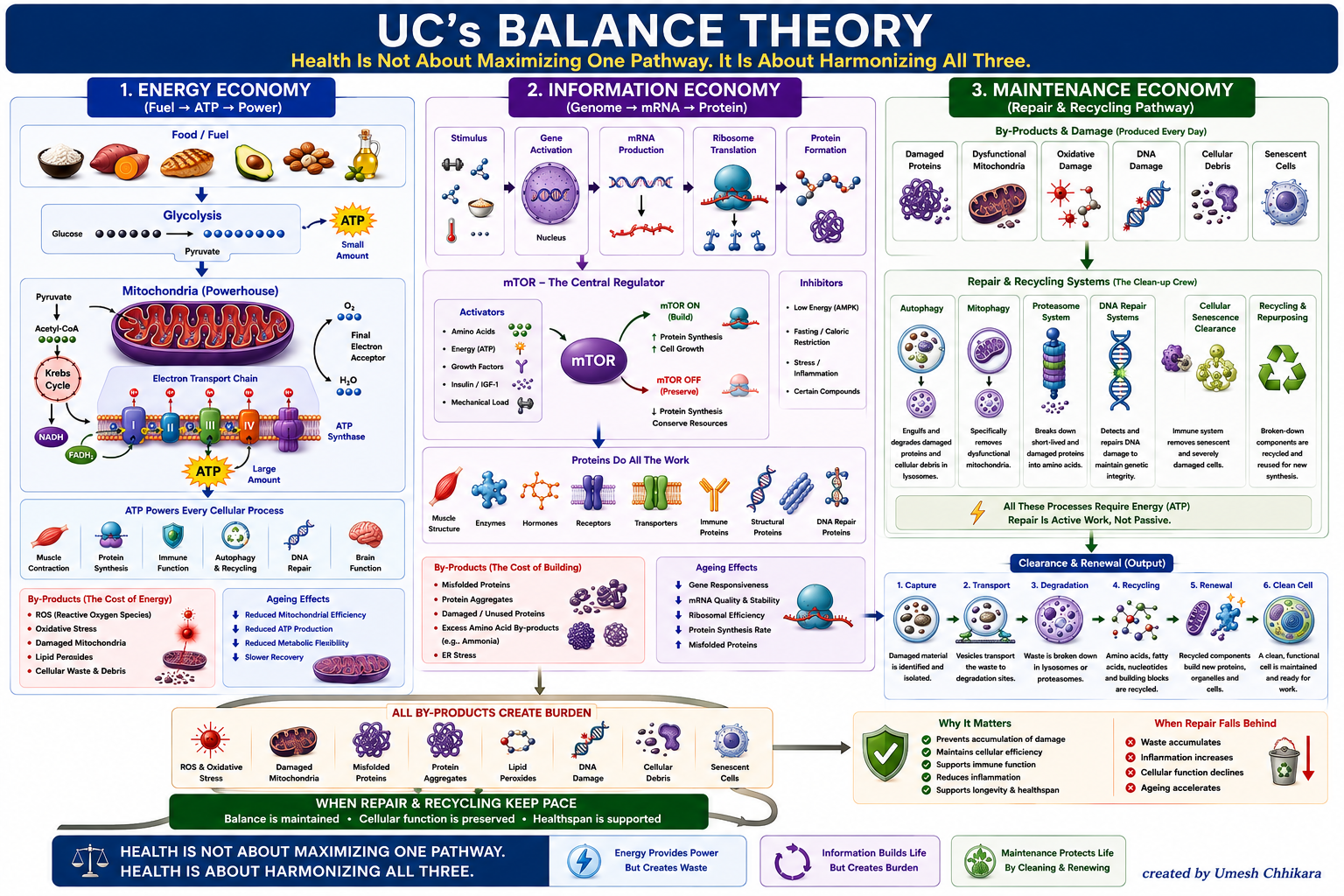
Every cell in the body is simultaneously managing three interconnected systems:
| System | Purpose |
|---|---|
| Energy Economy | Produces usable energy |
| Information Economy | Determines what gets built |
| Maintenance Economy | Repairs, recycles, and cleans |
These three systems are deeply interconnected. Energy powers protein synthesis and repair, protein synthesis creates maintenance demands, and repair itself consumes energy. If all three are interdependent, then any meaningful discussion of health and ageing must consider all three simultaneously.
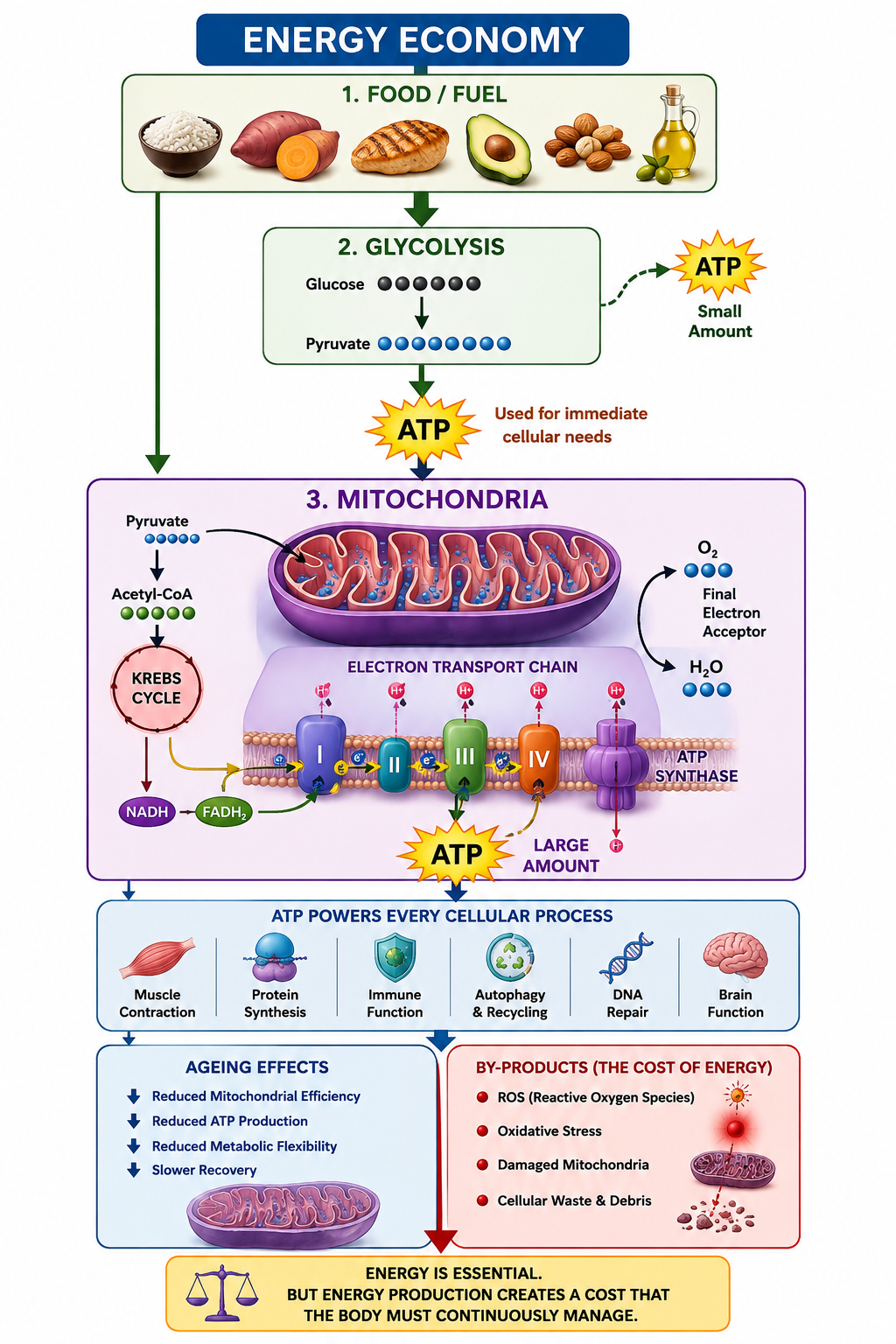
1. The Energy Pathway
At its most basic level, life requires energy.
Food is broken down into usable substrates that enter cellular pathways to produce ATP, the universal energy currency of the cell.
The simplified sequence looks like this:
Food → Glycolysis → ATP → Mitochondria → More ATP
Most people associate ATP with muscle contraction, but ATP powers virtually every process in the body, including protein synthesis, DNA repair, immune function, cellular transport, autophagy, hormone production, and brain function.
Without ATP, nothing happens.
However, energy production is not free. As mitochondria generate ATP, they also generate by-products such as reactive oxygen species (ROS), damaged mitochondrial components, and various forms of cellular waste.
The energy system therefore creates a paradox: the very process that keeps us alive also creates wear and tear that must later be repaired.
Ageing further complicates the picture. Mitochondria gradually become less efficient, metabolic flexibility declines, and recovery slows. The organism must work harder to maintain the same level of energy production it once achieved effortlessly.
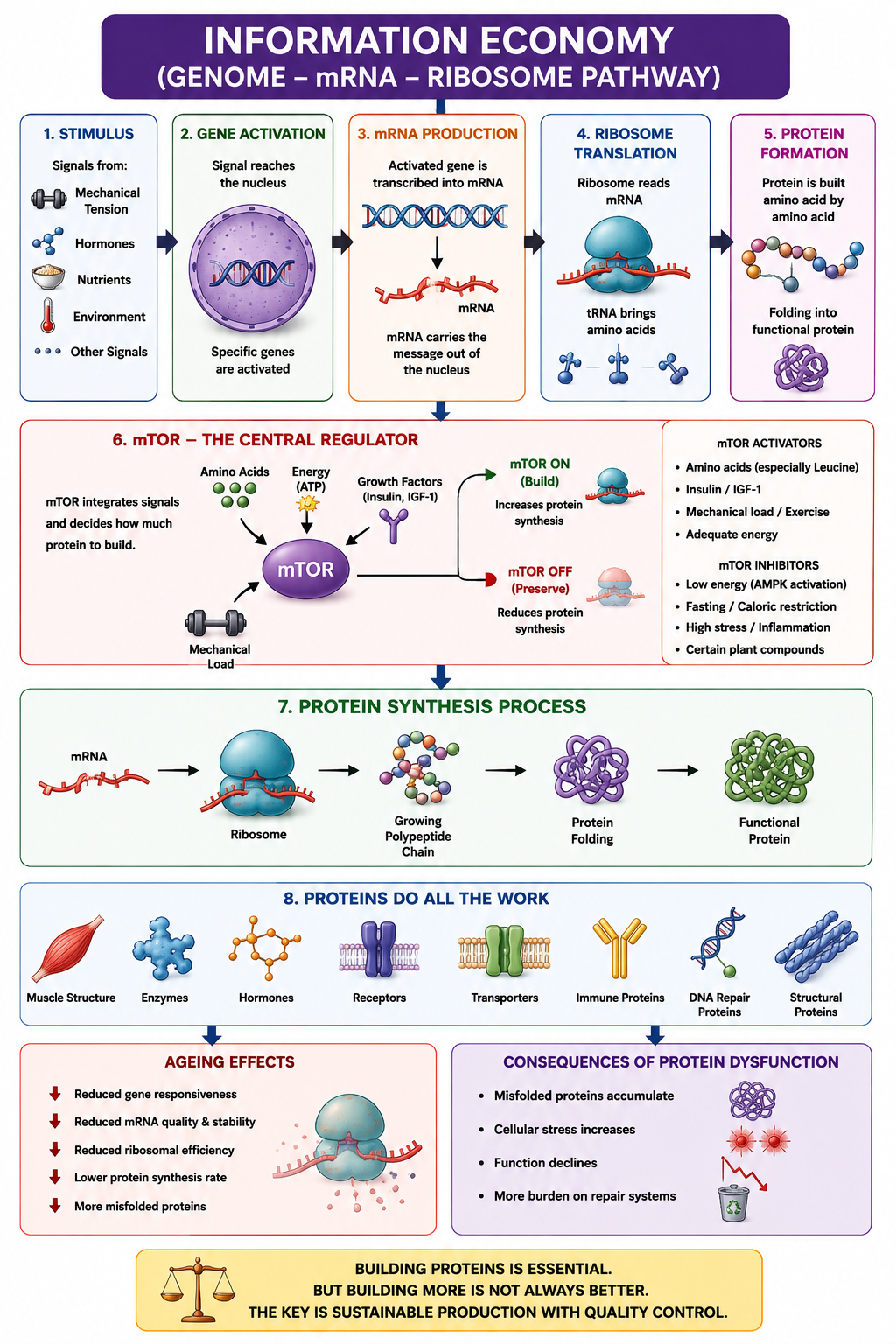
2. The Genome–Ribosome Pathway
If the energy system answers the question:
“How will the cell pay for it?”
then the genome-ribosome pathway answers:
“What should the cell build?”
The process is remarkably elegant.
A stimulus arrives. This stimulus may be mechanical tension from exercise, a hormone, a nutrient, a temperature change, or some other signal. The stimulus activates specific genes. Those genes generate messenger RNA (mRNA), which carries instructions from the nucleus to ribosomes. Ribosomes then read those instructions and manufacture proteins.
The simplified sequence, in my view, looks like this:
Stimulus → Gene Activation → mRNA → Ribosomes → Proteins
Muscle proteins are one outcome of this process. Enzymes, receptors, transport proteins, signalling molecules, immune proteins, and countless other structures are also produced through the same pathway.
Again, this system is not free. Every protein that is created must be folded correctly, maintained, monitored, and eventually recycled.
As we age, ribosomal efficiency declines, anabolic responsiveness decreases, protein quality control becomes less effective, and damaged or misfolded proteins begin to accumulate.
The challenge is no longer simply producing proteins. The challenge is maintaining the quality of those proteins.
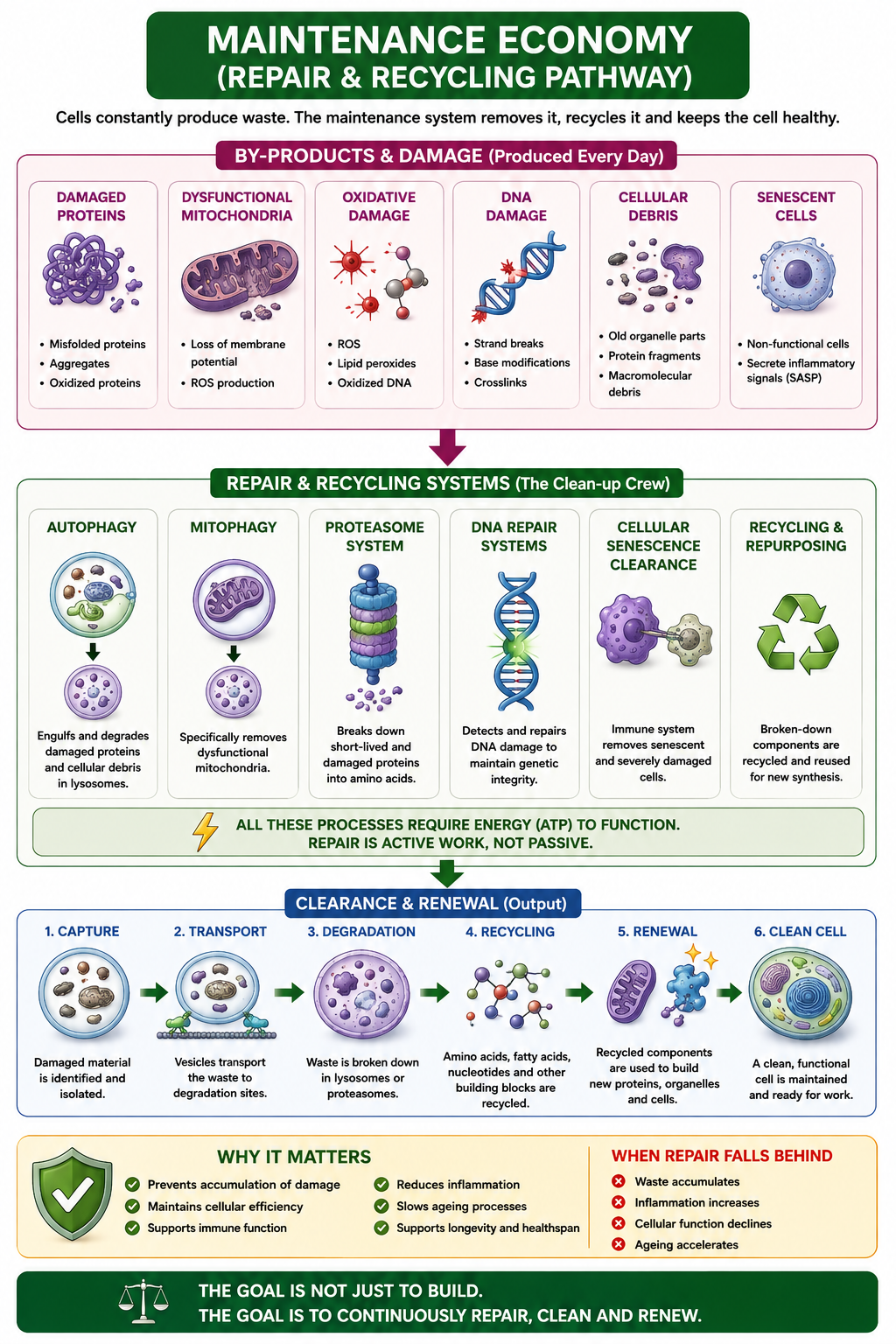
3. The Repair and Recycling Pathway
Every moment of life produces waste.
Cells generate damaged proteins, dysfunctional mitochondria, oxidized molecules, DNA damage, and cellular debris.
Without repair systems, these by-products would accumulate rapidly.
The body therefore relies on a vast maintenance network that includes autophagy, mitophagy, proteasomes, DNA repair systems, and immune surveillance.
These systems identify damage, remove dysfunctional components, recycle usable materials, and maintain cellular integrity.
Importantly, repair is not a passive process.
Repair requires energy. Autophagy requires energy. Mitophagy requires energy. Immune surveillance requires energy.
The maintenance economy must therefore draw resources from the energy economy in order to support the information economy.
As we age, these repair systems gradually lose efficiency. Waste begins to accumulate faster than it can be removed, resulting in a slow decline in cellular quality control.
The Problem with Single-Pathway Thinking
Modern health culture often focuses on one pathway at a time.
One camp wants to maximize muscle. Another wants to maximize mitochondrial function. Another wants to maximize autophagy. The problem is that none of these systems operate independently. More protein synthesis increases maintenance requirements. More energy production generates more by-products. More repair activity requires more energy. Every gain in one system creates demands elsewhere.
This brings us to the central idea of my Balance Theory.
Supplementation: Consider supplementation. Much of modern supplementation is built around the idea of enhancing a specific mechanism or pathway. The assumption is that if a pathway is beneficial, stimulating more of it must be even better.
But the push to enhance one mechanism rarely comes with corresponding adjustments to the other systems that support it. Any intervention that stimulates one process inevitably places new demands on the rest of the system. If one pathway is pushed harder, the others must adapt to meet the increased requirement.
Therefore, unless a genuine deficiency exists, how can we justify overstimulating one aspect of biology while leaving the rest untouched?
We have seen examples of this repeatedly. Vitamin D supplementation in people who are not deficient has not consistently produced the expected benefits and, in some cases, has come with unintended consequences. Cholesterol-lowering drugs often involve trade-offs. GLP-1 drugs deliver impressive benefits for some individuals but also come with compromises and side effects.
Even the concept of deficiency is not as straightforward as it appears. Deficiency thresholds are often derived from specific populations and may not be universally applicable. What appears deficient in one population may be entirely sufficient in another. A value considered low in the Western world may be normal in parts of Asia, and vice versa.
The key question is not whether a pathway can be stimulated. The key question is whether the entire system can maintain balance after that stimulation. In biology, every action has a cost, and every benefit creates a new demand somewhere else. Under Balance Theory, the goal is not to maximize individual pathways but to maintain harmony across the entire network.
Balance Theory
My Balance Theory proposes that healthspan depends on maintaining balance between:
- Energy production
- Protein production
- Repair capacity
The goal is not to maximize any one of these systems. The goal is to ensure that all three remain compatible with one another.
A useful analogy is a three-legged stool. One leg represents energy, one leg represents information and protein production, and one leg represents repair and recycling. Remove or weaken any leg and the system loses stability.
Health is therefore not the optimization of a pathway. It is the maintenance of balance between pathways.
Energy Balance
As we age, mitochondrial function gradually declines.
The issue is not simply that less energy is produced. The issue is that every unit of energy production carries a maintenance cost.
Energy production creates ATP, but it also creates waste products that must be managed.
The goal therefore is not maximum energy production. The goal is energy production that remains compatible with the body’s ability to maintain and repair itself.
Information Balance
Protein synthesis is essential. Without it, tissues cannot be maintained.
However, protein synthesis is not free. Every protein that is produced must eventually be monitored, repaired, recycled, or removed.
As ribosomal efficiency and quality control decline with age, the challenge becomes maintaining an appropriate balance between construction and maintenance.
The goal is not maximum protein production. The goal is sustainable protein production.
Repair Balance
Repair systems are often discussed as though they operate independently.
They do not.
Repair systems require both energy and resources. If damage accumulates faster than repair capacity, dysfunction emerges.
The challenge of ageing is not simply generating more repair. It is ensuring that repair capacity remains capable of keeping pace with the demands created by the rest of the system.
Health declines when maintenance falls behind construction.
Maintenance-Compatible Muscle Mass (MCMM)
A useful example of this Balance Theory is what I call:
Maintenance-Compatible Muscle Mass (MCMM) – a concept by UC
MCMM is not the amount of muscle a person can build. It is the amount of muscle a person can sustainably maintain while eating ordinary food, recovering normally, maintaining healthy biomarkers, remaining physically capable, and avoiding excessive physiological strain.
This distinction is important.
Most people ask:
“How much muscle can I build?”
A better longevity question may be:
“How much muscle can my entire system sustainably support?”
If an individual naturally settles at a certain level of muscularity while eating ordinary food, maintaining good function, displaying healthy blood markers, and avoiding excessive recovery demands, that muscle mass likely reflects a sustainable biological equilibrium.
MCMM is merely one example. The broader principle applies to every aspect of health.
The Real Goal of Healthspan
Ageing is often viewed as the failure of a single pathway.
Balance Theory suggests otherwise.
Ageing may instead represent the gradual loss of harmony between energy generation, protein production, and repair and recycling.
The healthiest state is not necessarily the one with the most muscle, the highest calorie intake, the greatest mitochondrial activity, or the most autophagy. It is the state in which all three systems remain balanced.
Importantly, that balance is highly individual. We cannot assume that the same calorie intake, protein intake, training volume, or body composition is optimal for everyone. Each person must find the level of energy production, protein turnover, and repair capacity that their system can sustainably support.
The future of longevity may not lie in asking how much we can push a pathway. It may lie in discovering how much our entire system can sustainably maintain.
That, ultimately, is the essence of this proposed Balance Theory.
Question: Could there be evidence of Balance Theory in action? Could it explain why runners, badminton players, and tennis players often outlive their peers?

