
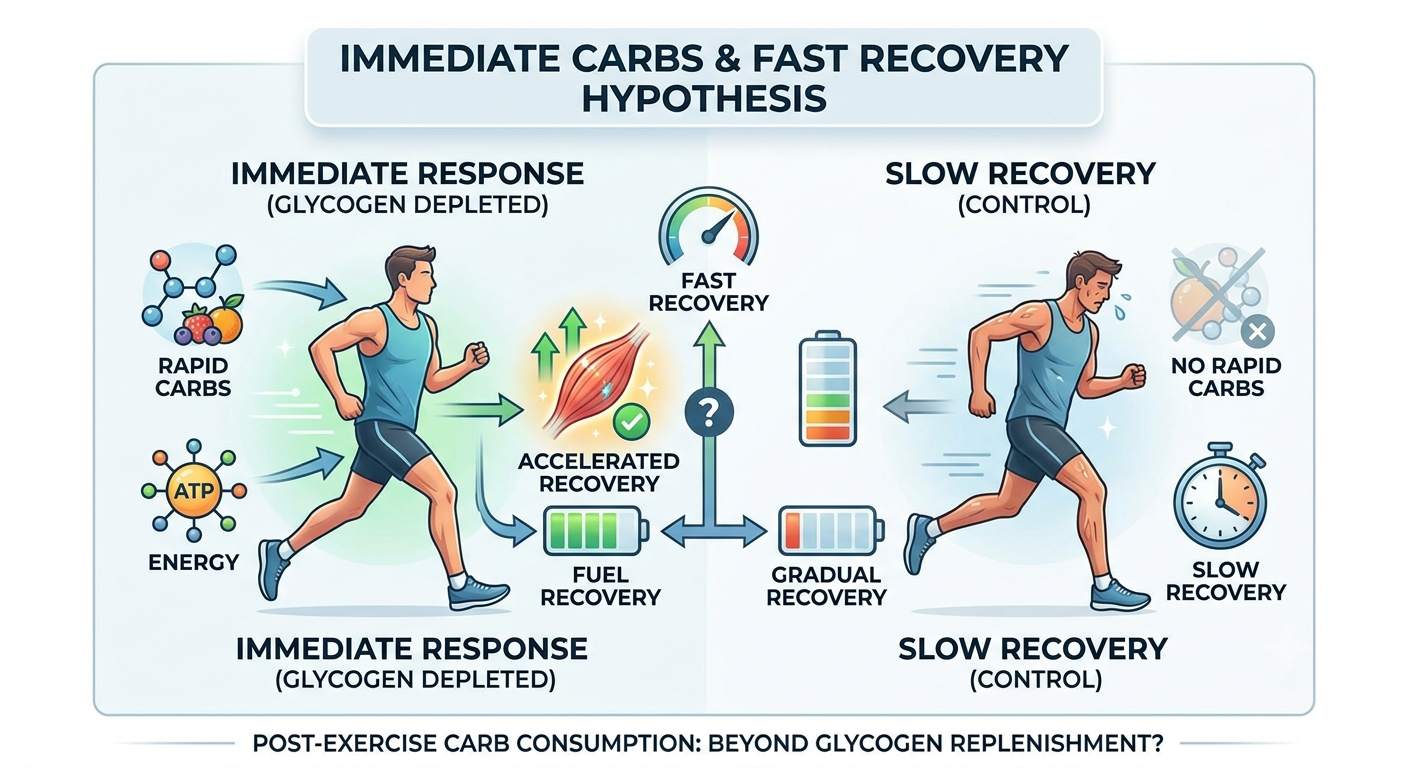
For years, the conventional advice around post-exercise nutrition has focused heavily on protein. The emphasis is usually on muscle protein synthesis, muscle repair and growth. Carbohydrates are generally discussed in the context of replenishing glycogen stores.
But I have a question:
What if consuming rapidly absorbable carbohydrates immediately after exercise does more than replenish glycogen? What if it also helps accelerate recovery from fatigue?
This is my hypothesis. I have experimented with this approach on myself and my students, and the observations have been interesting. However, I cannot claim with certainty that the benefits I have observed are caused by faster recovery rather than simply by glycogen replenishment. This is something I intend to investigate through proper testing.
Let me explain the reasoning behind my hypothesis.
1. What happens when we deplete muscle glycogen?
During demanding exercise, particularly when glycogen stores are substantially depleted, the muscles experience a range of physiological disturbances. Glycogen availability declines, inorganic phosphate accumulates, calcium handling can become less effective, and the ability to sustain high-intensity muscular contractions may deteriorate.
In my view, glycogen depletion affects normal post-exercise performance. Therefore, my hypothesis is not directed solely at sportspeople who may need to train again. In fact, it is more relevant to the general population who exercise and then go about their usual day, including working, moving around and carrying out daily activities.
The muscle needs to restore its functional state to go through the day. This involves restoring ion gradients, managing exercise-induced cellular disturbances, repairing damaged structures and maintaining mitochondrial quality through processes such as autophagy and mitophagy. These processes require energy, although they are also regulated by signalling pathways and the nature of the cellular disturbance.
The body can continue producing energy from fat and other available substrates. I am not suggesting that the muscles cannot recover without consuming carbohydrates. My question is whether providing rapidly available carbohydrate immediately after exercise can accelerate some aspects of that recovery.
2. Is the muscle particularly receptive to glucose after exercise?
Yes. Exercise stimulates glucose uptake by skeletal muscle through mechanisms that partly operate independently of insulin. Following exercise, insulin sensitivity is also generally enhanced. When muscle glycogen stores have been depleted, the muscle has a strong stimulus to replenish them. Consuming carbohydrates provides glucose that can support glycogen synthesis.
This is one reason carbohydrate intake after demanding exercise is useful, particularly when another training session or competition follows within a short period.
However, I want to explore a possibility beyond glycogen restoration.
The exercised muscle has a demand that extends beyond its glycogen stores. It also needs to restore normal function and manage the consequences of exercise. If readily available carbohydrate increases substrate availability and supports energy production, could it help some of these restoration processes proceed faster?
That is the question I want to investigate.
I am not suggesting that glucose automatically accelerates every repair mechanism. Some cellular quality-control pathways are themselves regulated by energy stress, nutrient availability and signalling. The relationship is more complex than simply supplying more calories. And I am definitely not saying that the fat is incapable of any of this or there is any scarcity of glucose in the body.
I am asking if – readily available carbohydrate increased substrate could help some of these restoration processes proceed faster?
My hypothesis is that the timing and availability of carbohydrate may nevertheless influence the overall recovery response.
3. Two people, the same meal, but a different metabolic state
Consider two people who have both eaten breakfast at 9 a.m.
At noon, the first person has completed demanding exercise and substantially depleted muscle glycogen. The second person has not exercised and has relatively well-maintained glycogen stores.
Both consume 150 calories of mixed fruit juice.
Although the calorie intake is identical, I would expect the immediate metabolic response to differ.
Person A: Glycogen depleted
The glucose and fructose in the juice become available for metabolism. Fructose is substantially processed by the liver, while glucose can be taken up by skeletal muscle. Some of the carbohydrate can replenish liver glycogen, and glucose availability supports muscle glycogen resynthesis. Because the muscles have depleted their glycogen stores, there is a strong demand for replenishment.
The carbohydrate can therefore serve a useful metabolic purpose beyond simply adding calories to the person’s diet.
My hypothesis is that this sudden availability of carbohydrate may also support the restoration of muscle function and potentially accelerate recovery from fatigue.
Person B: Glycogen relatively replete
The second person consumes the same juice, but the demand for muscle glycogen restoration is lower.
The carbohydrate can still be oxidized or stored as glycogen. Depending on the dose, the person’s metabolic state and the availability of other nutrients, some carbohydrate may also contribute to hepatic de novo lipogenesis. The important point is that the same food can have a different metabolic fate depending on the body’s physiological state.
This does not mean that the second person automatically converts most of the juice into fat. Nor does it mean that the first person cannot store fat. It means that glycogen depletion changes the body’s capacity and demand for carbohydrate storage.
This difference in nutrient partitioning is an established physiological concept. Whether it also translates into faster overall recovery is the question my hypothesis addresses.
4. Could replenishing energy help the muscle recover faster?
This is the central part of my hypothesis.
Recovery is not a single process. It involves restoring energy reserves, normalizing cellular function, repairing exercise-induced damage and adapting to the training stimulus. Some of these processes require ATP. Glucose can contribute to ATP production, while fat oxidation supplies a substantial proportion of energy during recovery at rest.
My proposition is that rapidly available carbohydrate, when consumed after substantial glycogen depletion, may support the recovery process in two ways.
First, it provides substrate for glycogen resynthesis, restoring the muscle’s capacity to produce energy.
Second, it may support energy-demanding processes involved in restoring cellular function.
I cannot yet establish whether the second effect occurs independently of glycogen replenishment. That distinction is important. A person may perform better after consuming carbohydrate simply because glycogen has been restored, without any acceleration of tissue repair or other recovery processes.
My hypothesis is that the effect may extend beyond this, but that requires investigation.
5. What about the body’s stress state?
There is another possibility worth exploring.
After demanding exercise, the body must respond to both metabolic disturbances and the broader physiological demands of the session. The person’s autonomic state, hormonal regulation, sleep and psychological stress can all influence recovery.
I wonder whether rapidly restoring available carbohydrate after substantial glycogen depletion may contribute to a faster transition towards a more recovered physiological state.
I am not suggesting that glucose automatically switches the body from sympathetic to parasympathetic activity. Nor am I claiming that energy is consciously directed towards the muscles according to where attention is placed.
Rather, I am asking whether the combination of glycogen restoration, substrate availability and changes in physiological demand can influence the overall recovery response.
This remains a hypothesis, not an established mechanism.
6. Could carbohydrate intake also influence spontaneous physical activity?
Consider two people sitting in a café at noon. One consumes a glass of fruit juice containing approximately 150 calories, while the other drinks water.
My hypothesis is that the person who consumes the juice may subsequently feel more energetic and engage in more spontaneous movement, whether through fidgeting, changing posture or simply being more active. If that occurs, the energy intake may influence subsequent energy expenditure as well as substrate availability.
QUES: Would both people be burning the same energy?
There is an important distinction here: increased spontaneous activity is not an inevitable response to carbohydrate intake. It varies between individuals and circumstances and must be measured rather than assumed. Nevertheless, it is worth investigating whether post-exercise carbohydrate feeding influences spontaneous activity in people who have depleted their glycogen stores. Also the body has to deal with quick absorption of calories…how it does it?
This also relates to the broader observation that short-term overfeeding does not always translate directly into equivalent fat gain. The body can adjust energy expenditure and substrate use, although these compensatory responses vary and do not eliminate the effects of sustained energy surplus.
7. My own observations
I have experimented with this approach on myself and my students.
One example from my own experience was adding a large glass of mixed fruit juice immediately after exercise without increasing the amount of exercise I performed. I did not observe the weight gain I might have expected from simply adding those calories to my diet. This observation is consistent with the possibility that the timing of carbohydrate intake and the body’s metabolic state influence how those calories are handled.
However, I cannot conclude from this observation alone that the juice calories were entirely directed towards glycogen replenishment, that fat storage was prevented, or that cellular recovery was accelerated. I have also observed responses in my students that have encouraged me to explore the idea further. But personal observations, even when repeated, cannot establish the mechanism with certainty.
That is why I want to test this properly.
8. Why I want to investigate this
I am not arguing that carbohydrates are always superior to protein after exercise. Protein supplies amino acids required for muscle protein synthesis and tissue remodelling. Carbohydrates support glycogen restoration and can contribute to energy production. Their relative importance depends on the training stimulus, the extent of glycogen depletion, the timing of subsequent exercise and the person’s nutritional needs.
My specific question is narrower:
When muscle glycogen has been substantially depleted, does consuming rapidly absorbable carbohydrate immediately after exercise do more than replenish glycogen? Can it accelerate recovery from fatigue, improve subsequent functional performance or influence spontaneous physical activity?
I intend to investigate this through proper testing, with appropriate controls and measurable outcomes. The study would need to distinguish glycogen replenishment from recovery of muscle function, and both from changes in subjective fatigue or spontaneous movement. These outcomes may be related, but they are not interchangeable.
Until then, I will treat my observations as preliminary and my proposed mechanism as a hypothesis. I believe research should begin with reasonable questions about physiology, not only with mechanisms that have already been conclusively demonstrated.
This is one such question. I look forward to testing it.
Why mixed fruit juice?
A fast-absorbing carb like juice floods the blood quickly, and depleted muscle with elevated GLUT4 grabs it fast, which is why you saw muscle glycogen refill in the same or less time than a slower meal. The juice isn’t magic; it’s just the fastest way to get glucose into circulation when the muscle is primed to take it.

