
This new study is fascinating, but I think it can very easily be misunderstood.
https://physoc.onlinelibrary.wiley.com/doi/10.1113/JP291728
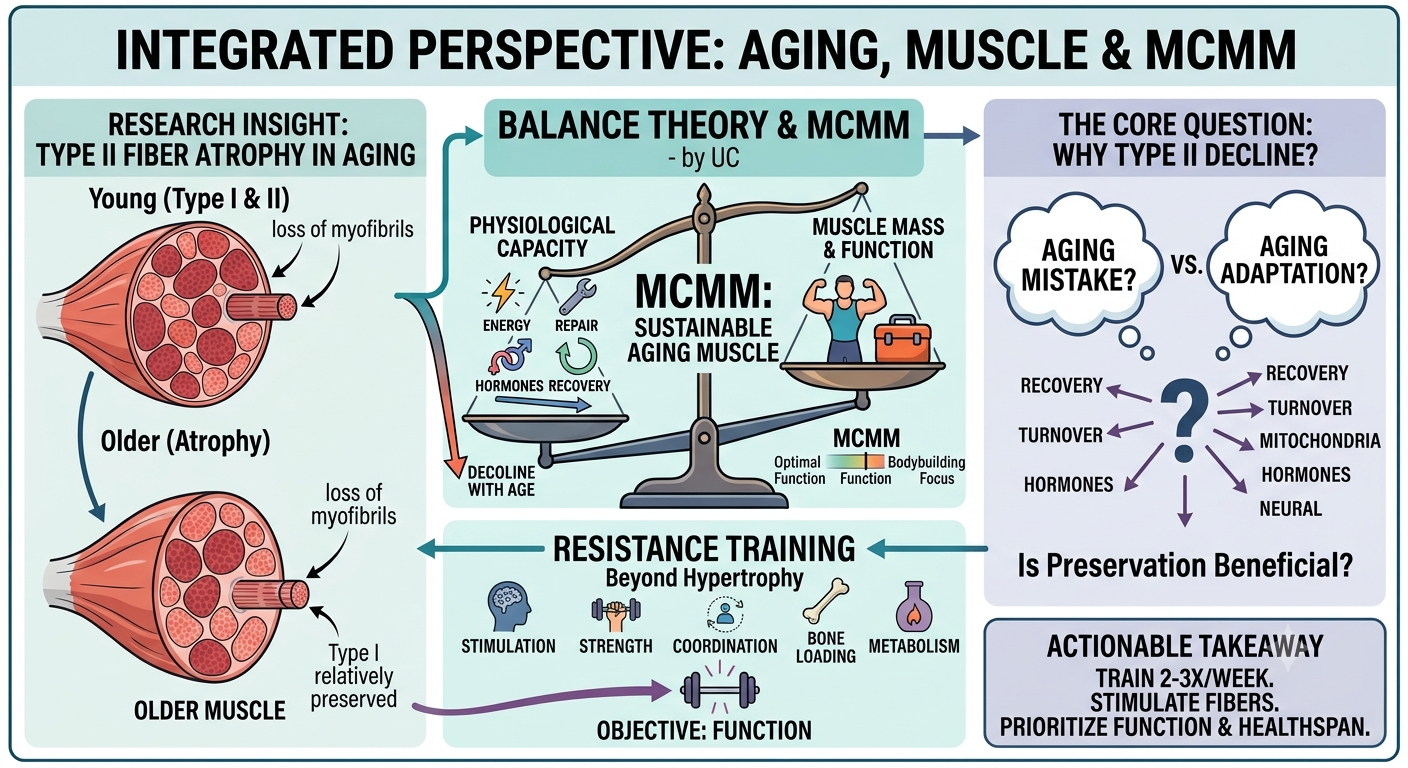
Research Findings: Researchers found that ageing-related muscle loss is driven primarily by the loss of myofibrils inside Type II muscle fibers rather than by the myofibrils simply becoming smaller. In humans, Type II fibers became smaller with age, while Type I fibers were relatively preserved.
The obvious response from the fitness industry will be:
“See? We lose Type II fibers as we age. Therefore, we must do resistance training and maintain as much muscle mass as possible.”
I don’t think we can make that conclusion yet.
……………………………………………………………………………………………………………………………………………………………………………….
And this is where my concepts of MCMM: Maintenance Compatible Muscle Mass and Balance Theory become relevant.
1. Why resistance training is important
I have no doubt that resistance training should remain part of our lives as we grow older. But I don’t see resistance training primarily as a tool to keep building muscle. Its value is much broader. Resistance training provides mechanical and neurological stimulation. It helps maintain strength, power, coordination, bone loading, physical capability and many metabolic functions.
So there are plenty of reasons to continue resistance training even when muscle hypertrophy is no longer the objective.
2. We should preserve function, not chase muscle size
This is where I differ from the conventional fitness narrative. The objective of ageing should not be: “How much muscle can I preserve?”
The objective should be: “How much physical function can I preserve?”
Strength, power, balance, mobility, the ability to get up from the floor, climb stairs, carry something, react quickly and remain physically independent may matter far more than maintaining the muscle mass of a younger person. Muscle is a means to an end, not necessarily the end itself.
Influencers are way too much muscle centric!
3. Type II fibers are declining for a reason — and we don’t yet know what that reason is
This is the part I find most interesting. The study shows that Type II fibers decline with ageing. But it does not establish that the body is making a mistake by allowing them to decline. Perhaps we are simply losing the capacity to maintain the same number of Type II fibers. That distinction is important.
As we age, the entire organism changes. Recovery changes. Protein turnover changes. Neural function changes. Hormonal signalling changes. Mitochondrial function changes. Repair capacity changes. Energy availability and energy requirements change.
So perhaps the body is not simply “losing muscle.” Perhaps the muscle is being progressively adjusted to what the ageing organism can maintain.
This is the thinking behind my concept of MCMM — Maintenance Compatible Muscle Mass. MCMM does not mean the muscle mass that we can build. It means the muscle mass that the whole organism can sustainably maintain.
4. This is where Balance Theory comes in
I have argued through my Balance Theory that biological health cannot be understood by maximizing one physiological variable in isolation. The organism has to balance energy production, growth, repair, maintenance, recovery and function. Muscle is one part of this system.
If the rest of the organism is ageing and its capacity for maintenance and repair is declining, why should we automatically assume that maintaining the muscle mass of a 30-year-old is biologically desirable at 80? We don’t know.
And this is where I think we need to be intellectually honest.
The fact that Type II fibers decrease with age does not prove that preventing that decrease will extend lifespan or even necessarily improve healthspan. We don’t have that evidence yet.
5. So should we try to maintain Type II fibers?
I think we should stimulate them. That is different from saying that we should preserve maximum muscle mass at all costs. Resistance training gives the body a reason to continue using and maintaining Type II fibers. It makes sense to continue providing that stimulus throughout older age. But whether maintaining a larger number of Type II fibers actually changes the trajectory of human ageing is something that only long-term human data can tell us.
Perhaps it will be enormously beneficial. Perhaps the benefits will be modest. Perhaps the body will still progressively reduce Type II fibers despite our best efforts because that reduction is part of normal ageing.
We simply don’t know yet. And I think this distinction is critical.
So what should we do?
My answer is quite simple:
- Resistance train 2–3 times a week.
- Continue to challenge the body.
- Continue to stimulate strength and power.
- Continue to use the Type II fibers.
- Do walk and cardio training – whatever you can manage with age
- Do stretching & mobility work regularly
But don’t turn ageing into a never-ending bodybuilding project because just RT wouldn’t cut it. The objective SHOULD NOT be to keep adding muscle. It should be to keep entire body healthy.
The objective is not even necessarily to preserve every Type II fiber.
The objective is to preserve as much function as possible while allowing the muscle to remain compatible with the changing physiology of the entire organism. That is MCMM.
And that is where Balance Theory becomes important.
We cannot look at muscle in isolation and assume that more is always better. The human body is not a collection of independent systems competing for maximum performance. It is an integrated system constantly adjusting itself to maintain equilibrium.
Maybe the reduction in Type II fibers is partly a consequence of ageing. Maybe it is partly an adaptation to the reduced capacity of the ageing organism to maintain them. Maybe it is both. We don’t know.
What we do know is that resistance training stimulates far more than muscle hypertrophy. It gives the ageing body a mechanical, neurological and metabolic stimulus that is difficult to replace through other forms of activity. Therefore, I would continue resistance training throughout older age, not because we have proven that preserving youthful muscle mass will make us live longer, but because the overall benefits of resistance training make it one of the most rational forms of physical activity for an ageing human. And then we watch what happens.
Because perhaps the most important question is not:
“How do we stop losing muscle?”
It is:
“How much muscle does an ageing human actually need, and what happens when we successfully maintain more of it?”
That question remains and it will be answered in our lifetime for sure.

