
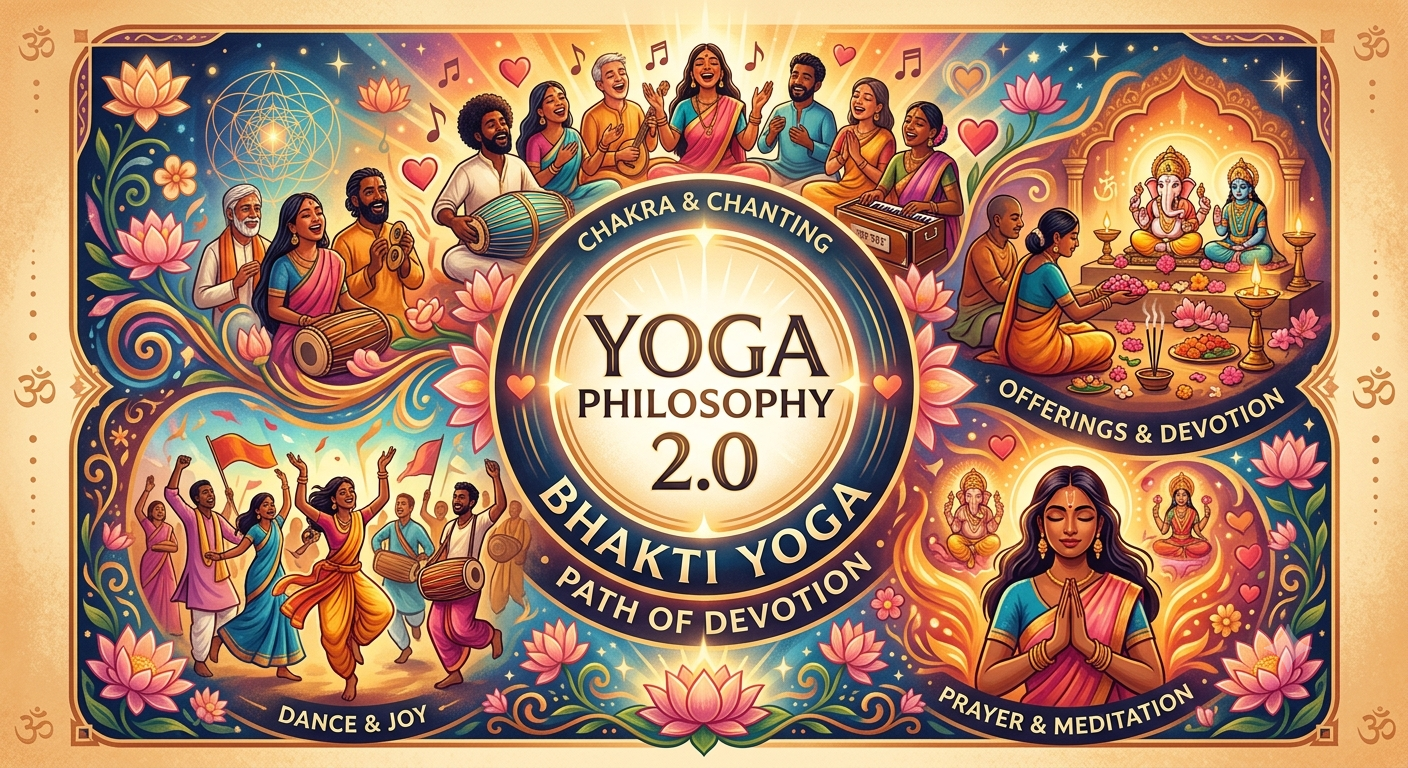
Bhakti Yoga
Continuing from my essays on Yoga Philosophy 2.0, this write-up covers Bhakti Yoga.
Bhakti Yoga is the path of devotion, channeling human emotion, love and surrender toward the Divine. While its roots appear in the Upanishads, it was most clearly articulated in the Bhagavad Gita, where Krishna presents devotion as a direct path to spiritual realization. Later texts such as the Narada Bhakti Sutras describe Bhakti as supreme love that brings inner peace and liberation.
One of the most influential expressions of Bhakti appears in the Bhagavata Purana, where Prahlada describes the Navadha Bhakti, or nine forms of devotion: hearing, chanting, remembering, serving, worshipping, reverence, selfless service, friendship and complete surrender to the Divine. These practices formed a traditional framework through which devotion could be cultivated in everyday life.
This is the classical understanding of Bhakti Yoga.
Bhakti Yoga 2.0
Before I take this discussion further, let me make one thing clear:
I am not trying to explain the “true” meaning of Bhakti Yoga. Nor am I challenging the ancient text itself.
What I am doing is taking an ancient idea, understanding the context in which it was presented, and then asking a different question:
Can we apply this ancient practice to the world we live in today?
Thousands of years ago, the human brain was the same, but our understanding of the brain, behaviour, emotions and the nervous system was obviously very different. Today, science gives us another language through which we can look at some of these ancient practices.
So this is not an attempt to teach Bhakti Yoga. It is an attempt to understand why some of these practices may have worked, what they may have been trying to achieve, and how they could be relevant to human beings today.
Bhakti is about emotion in my view.
We often translate Bhakti simply as devotion to God. I think that is too narrow an interpretation if we are trying to understand its relevance today. At its core, Bhakti deals with something fundamental to being human: emotion.
Human beings are emotional creatures. We love, hate, fear, admire, envy, become attached, seek belonging, worship, fight and sacrifice. Our emotions can bring out the very best in us, but they can also become the source of conflict, suffering and destruction.
The problem, therefore, is not emotion itself. The problem is unregulated emotion.
Perhaps the ancient yogis understood something very fundamental about human nature: you cannot simply switch emotions off. You have to channel them. Bhakti provided a direction for that emotion. Instead of allowing love, attachment, admiration and surrender to scatter across countless objects, people and desires, Bhakti directed them towards something higher and larger than the individual.
Traditionally, that was the Divine. In a modern interpretation, we can ask what happens to the human mind when it is given such a focused emotional anchor. And this is where the nine forms of Bhakti become interesting.
1. Hearing, Chanting and Worshipping – 3 key points
I would cover these three together because, although they appear as separate practices, they can produce a similar experience: focused & selfless attention.
Ques: What happens when we listen to something with our complete attention?
Our mind becomes focused on that subject.
Ques: What happens when the mind becomes focused?
Our attention narrows. Competing thoughts begin to fade into the background.
Think about listening to your favourite piece of music. For a few minutes, you may become completely absorbed in it. You are not thinking about yesterday’s argument, tomorrow’s meeting, your pending work or the hundred other things that normally occupy your mind. You are simply there. And then you lose it and your mind wanders back to your present world.
Chanting and worship can create a similar state and keep it steady for a long time.
When we chant repeatedly, particularly in a group, the rhythm, repetition, sound and collective participation give the mind very little reason to wander. Everyone is doing the same thing. The attention keeps returning to the same sound, the same words and the same activity. Whether you understand every word or not, you can become absorbed in the experience. This is why a person can attend the same prayer, chant or devotional ceremony for the hundredth time and still become engrossed in it.
The environment does something to the mind. The mind stops jumping from one thought to another and becomes anchored to the present experience. From a modern perspective, we could look at this as a form of attentional regulation. From the traditional perspective, it is Bhakti.
Both descriptions may be pointing towards the same human experience.
What happens to the brain?
When attention becomes deeply focused, mental chatter can reduce. The constant switching between thoughts, worries, memories and future plans temporarily decreases. This does not mean the brain becomes inactive. Quite the opposite. The brain remains highly active, but its activity becomes more organised around a particular experience rather than being continuously scattered across competing thoughts. And this can create a feeling of calm.
Repeated chanting, prayer, music and other contemplative practices may also influence the stress response and reward systems of the brain and body. The exact physiological response will vary between individuals and situations, so I would not reduce Bhakti to simply “lower cortisol and higher endorphins.”
The larger point is much simpler: When the mind becomes less scattered, we experience less mental noise.
And when mental noise reduces, we often experience calm.
Complete surrender
This makes the idea of “complete surrender to the Divine” particularly interesting. I don’t necessarily see surrender as weakness or giving up. I see it as temporarily giving the mind permission to stop controlling everything. We spend much of our lives trying to control outcomes, people, situations and the future. That constant mental resistance itself can become exhausting.
Surrender creates the opposite experience.
For a period of time, the individual stops trying to control and simply participates. In that sense, surrender can be understood as a powerful form of letting go of mental resistance. The ancient language calls it surrender to the Divine. Modern psychology may describe parts of the experience differently.
But the human experience remains remarkably similar.
What does this mean for the present-day world?
India has a huge population that would consider itself deeply devoted. People pray every day, visit temples, chant, fast and follow rituals passed down through generations. There is undoubtedly value in these practices. A daily ritual can provide structure. A temple can provide a change of environment. Prayer can provide emotional comfort. Chanting can quiet the mind. A community can create belonging.
But there is an important distinction in my view:
Practising a religious ritual is not necessarily the same as practising Bhakti Yoga.
Bhakti was not simply about performing a ritual. It was about what happened to the human being through devotion. If I pray every morning and then spend the rest of the day consumed by anger, jealousy, hatred, greed or resentment, what exactly has my Bhakti transformed? This is where I think we have to revisit the original purpose.
The benefit of a ritual may be real, but it can also be temporary if the underlying emotional behaviour does not change. And this may explain why a deeply religious society can still contain enormous conflict, intolerance, anger and division. The problem may not be the practice.
The problem may be that we have retained the ritual and lost the transformation.
Bhakti cannot work in isolation
This is also where the larger philosophy of Yoga becomes fascinating. If we focus entirely on Karma – action, achievement and responsibility, we can become stressed and consumed by doing. Bhakti gives us emotional connection and surrender. Jnana gives us understanding and wisdom. Raja Yoga gives us a method to work with and regulate the mind.
Perhaps this is why the four paths make more sense when viewed together.
Karma Yoga teaches us how to act.
Bhakti Yoga teaches us how to feel.
Jnana Yoga teaches us how to understand.
Raja Yoga teaches us how to work with the mind.
One without the others can leave us incomplete. This is why I believe Yoga Philosophy should not be treated as four disconnected paths or four different philosophies. It is a much more complete system when viewed as a whole. And perhaps that is where Bhakti Yoga becomes relevant to the modern world.
Not as a religious ritual. Not simply as prayer. But as an ancient understanding that human emotion needs direction.

