
Treadmill vs Outdoor Running: A Biomechanist’s Perspective
How is treadmill running biomechanically different from outdoor running?
Let me address this as a biomechanist who spent nearly 10 years running primarily on a treadmill, followed by another 10 years running outdoors – typically five days a week; and who still does both depending on time and circumstances.
When I think of biomechanics, I am looking at:
– Foot strike pattern Joint sequencing
– Hip-knee-ankle coordination
– The stretch-shortening cycle
– Overall movement strategy
From that perspective, treadmill and outdoor running are remarkably similar, especially when the treadmill is set at a 1% incline.
Most runners do not suddenly switch from a quad-dominant to a hamstring-dominant pattern simply because they step onto a treadmill. The belt cannot run for you. The runner still has to generate force into the ground.
Every step still requires:
– Bodyweight support Impact absorption Elastic energy storage and return Plantarflexion through the calf complex
– Hip extension Stabilization through the trunk and pelvis
– The posterior chain does not disappear because the belt is moving beneath the body.
This is why I struggle to understand the argument that treadmill running is somehow a poor substitute for outdoor running.
Yes, from a mechanical standpoint, there are differences in the environment:
– Air resistance is absent.
– Visual flow is absent.
– The belt moves beneath the runner.
– Some treadmills are more compliant than asphalt or concrete.
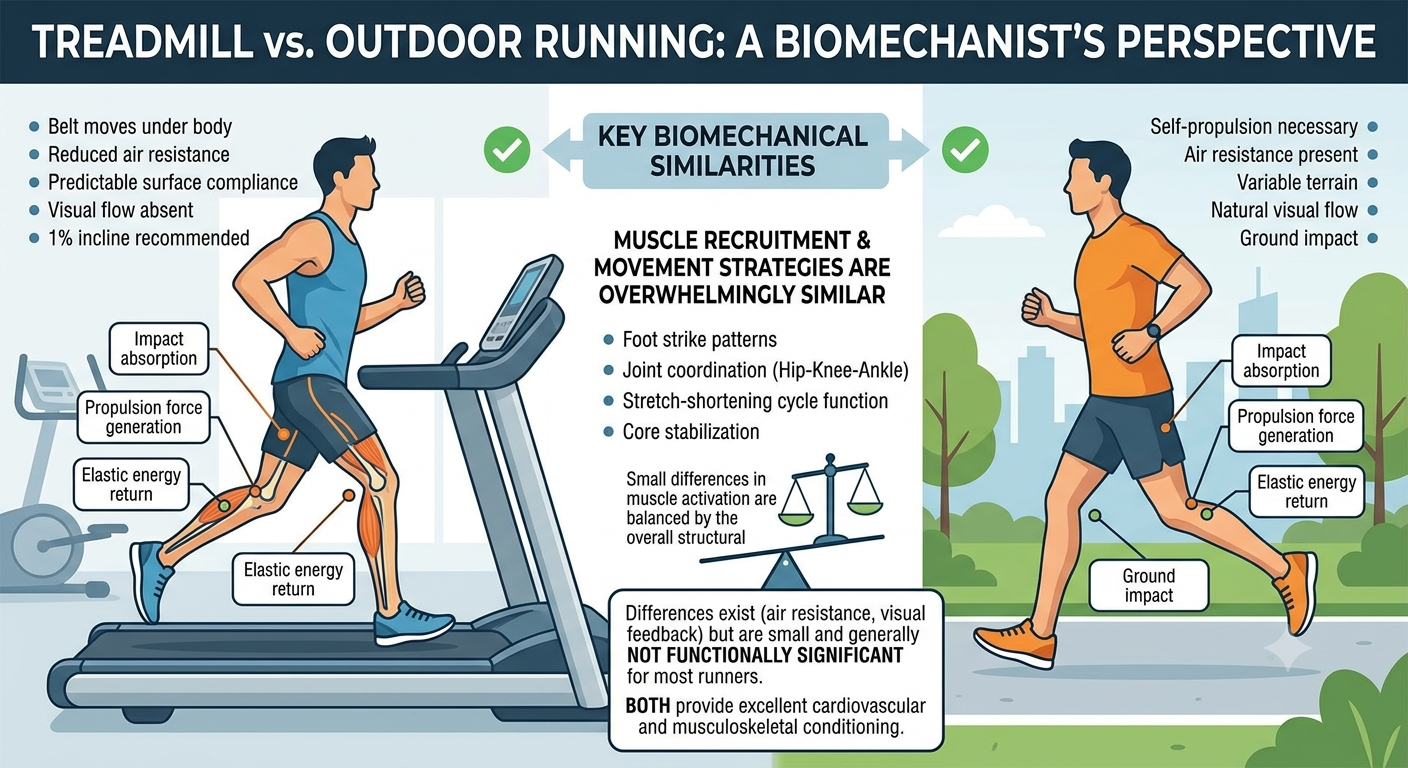
But the real question is not whether differences exist. The real question is whether those differences are large enough to matter?
For an elite athlete competing at the highest level, perhaps they do. Small changes in force application, running economy, or environmental adaptation may be relevant.
For someone running two or three times per week for health, fitness, weight management, cardiovascular conditioning, or general wellbeing, the differences are unlikely to be meaningful. A statistically significant difference is not automatically a functionally significant difference.
For example, a 3–5% change in hamstring EMG activity may be detectable in a laboratory.
But if pace, cadence, stride length, foot strike pattern, and overall movement strategy remain unchanged, then the neuromuscular demands of the task remain overwhelmingly similar.
In practical terms, the body still recognizes the activity as running. The major tissues are loaded in the same sequence, the same movement patterns are repeated, and the same fundamental physiological systems are challenged. For most people, treadmill running is not a different activity. It is simply running performed in a slightly different environment. Its easier as it can challenge the system more than one could with flexibility of speed.
As a matter of fact, even the meditative states while running is same as it is dependent on mind and not track.

