
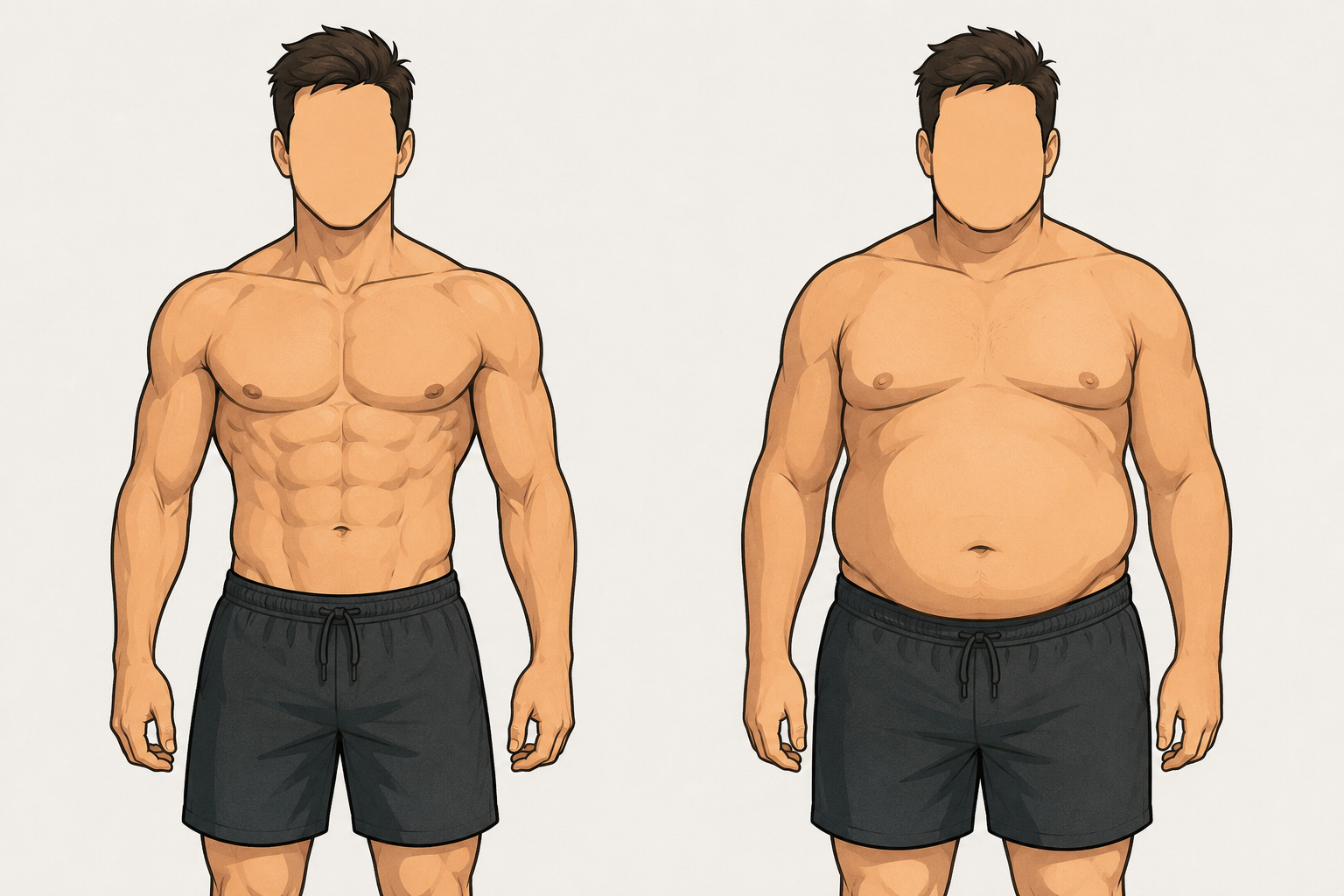
I am not sure about overseas, but in India a phenomenon among gym-goers is very visible and most of us may have noticed it.
People often start looking softer, heavier, and visibly fatter very quickly after they stop training. Many of these individuals had previously lost fat after joining the gym, and therefore the research I discuss below directly speaks to this crowd.
Most people look at a former gym-goer who expands in four to six weeks and reach for the same explanation:
“He stopped training, so he burns less and is still eating the same. Surplus calories.”
That story is incomplete.
Over the last one and a half decades, I have overall spent hundred of hours in gyms, trained hundreds of athletes outside of gym, and observed several hundreds in the gyms. The pattern is remarkably consistent. Many people gain weight surprisingly quickly after training stops, even when their overall lifestyle remains largely unchanged.
The explanation is usually reduced to the calories burned during exercise. But exercise itself contributes only a fraction of total daily energy expenditure. Most people who stop training do not simultaneously stop working, walking, climbing stairs, or carrying out daily activities. They remain active human beings.
The more important question is not:
“How many calories did the workout burn?”
It is:
“What metabolic processes disappear when training stops?”
A recent study provides an important clue.
The Research That Changes the Picture: https://www.nature.com/articles/s41366-026-02179-z
In a 2026 paper published in the International Journal of Obesity, researchers examined recreational athletes who lost weight while performing resistance training and consuming adequate protein.
Resting energy expenditure (REE) still fell by roughly 140 kcal per day, even in individuals who gained fat-free mass. In other words, the body can lower its baseline energy expenditure independently of how much muscle it currently carries.
That finding matters far beyond weight loss studies. It suggests that metabolism is not determined solely by muscle mass. The body can become more energy efficient even when lean tissue is preserved. This helps explain why the post-training weight rebound often appears larger and faster than many calorie-based models would predict.
The classic calorie argument treats expenditure as relatively fixed and focuses almost entirely on intake. But when training stops, several overlapping physiological shifts occur simultaneously. Together they create conditions that favour fat gain even when food intake appears broadly similar.
Component 1: Adaptive Downregulation of REE
The body does not permanently keep its calorie-burning rate linked to how much muscle you have. This study showed that clearly. Even when people maintained or gained muscle, their resting metabolism dropped more than expected.
(Resting metabolism is the amount of energy (calories) your body uses to keep you alive and functioning while at complete rest, supporting processes such as breathing, circulation, and cellular maintenance.)
Once the body shifts into a lower-energy mode, it starts using fewer calories to do the same work. This is important because many people believe that if they keep most of their muscle, their metabolism should stay the same.
The evidence suggests that is not always true.
Component 2: Loss of the Anabolic Demand
Resistance training does more than burn calories during a workout. It creates an ongoing demand for muscle repair, protein turnover, glycogen replenishment, and other adaptations that continue long after the session ends.
All of these processes require energy.
When training is regular, nutrients and calories are constantly being used to support recovery and adaptation. When training stops, much of that demand disappears. The workout may have lasted only an hour, but the body’s response to it was operating throughout the day.
As a result, the body loses an important destination for incoming nutrients, making it easier for excess energy to be stored.
Component 3: Changes in Nutrient Partitioning
Regular training helps direct nutrients toward recovery, repair, adaptation, and restoring energy stores.
When the training stimulus is removed, this demand weakens. The same nutrients that were previously used to support these processes now have fewer productive destinations. As a result, a larger proportion becomes available for storage.
This is why looking only at calories burned during exercise can be misleading. The real question is not just how many calories are used, but where nutrients are being directed inside the body.
Component 4: The Indian Dietary Shift
This mechanism is particularly relevant in India.
In many Western populations, people who stop training often continue eating large amounts of animal protein because that remains part of their normal diet. Basically saying their food don’t change much.
India is different.
A large number of gym-goers temporarily adopt a high-protein eating pattern while training – egg whites, chicken breast, whey protein, paneer, and other gym-associated foods. Once training stops, many abandon this pattern almost immediately.
- Ten egg whites become four chapatis.
- Chicken becomes extra servings of rice.
- Protein shakes disappear.
- Snacks, sweets, and traditional comfort foods return.
Two consequences follow:
- The thermic effect of food declines because protein is energetically expensive to process. Its very small in my view because, in India, we don’t eat stake or any meat that requires too much chewing. However, TEF difference is real.
- The nutrients that previously supported muscle remodeling and recovery are no longer required for that purpose.
The result is not simply a dietary change. It is a shift toward a lower-cost metabolic state occurring at exactly the same time that training-related demands have disappeared.
Why Exercise Calories Alone Don’t Explain It
The popular explanation assumes that the entire effect comes from the calories burned during workouts. But that does not fully fit what we observe. Exercise contributes only a portion of total daily expenditure. Most former gym goers continue to live active lives.
They work. They walk. They move. They are not suddenly confined to a couch.
Yet many still gain weight rapidly. The more plausible explanation is that stopping training changes the body’s entire energy economy.
- A lower REE.
- Reduced anabolic demand.
- Altered nutrient partitioning.
- Lower dietary thermogenesis.
All of these occur together.
Looking only at exercise calories ignores the much larger physiological system surrounding training.
Putting It All Together
You now have:
- A lower baseline metabolic burn through adaptive reductions in REE.
- The disappearance of a continuous energy-consuming anabolic process.
- Reduced demand for repair, recovery, and tissue remodeling.
- Altered nutrient partitioning that favours storage.
- A dietary shift that lowers the energetic cost of processing food.
The result is a positive energy balance driven largely by falling expenditure, changing metabolic demands, and altered nutrient allocation.
The calorie model is not wrong. Energy balance still governs body weight.
But the phrase “he’s eating more than he’s burning” tells us almost nothing about the mechanisms that created that imbalance. The more important question is why expenditure fell and why nutrients are no longer being directed toward the same destinations.
That is where the physiology lies.
And that physiology explains why so many former gym-goers in India gain weight rapidly after training stops even when they believe very little has changed.

