
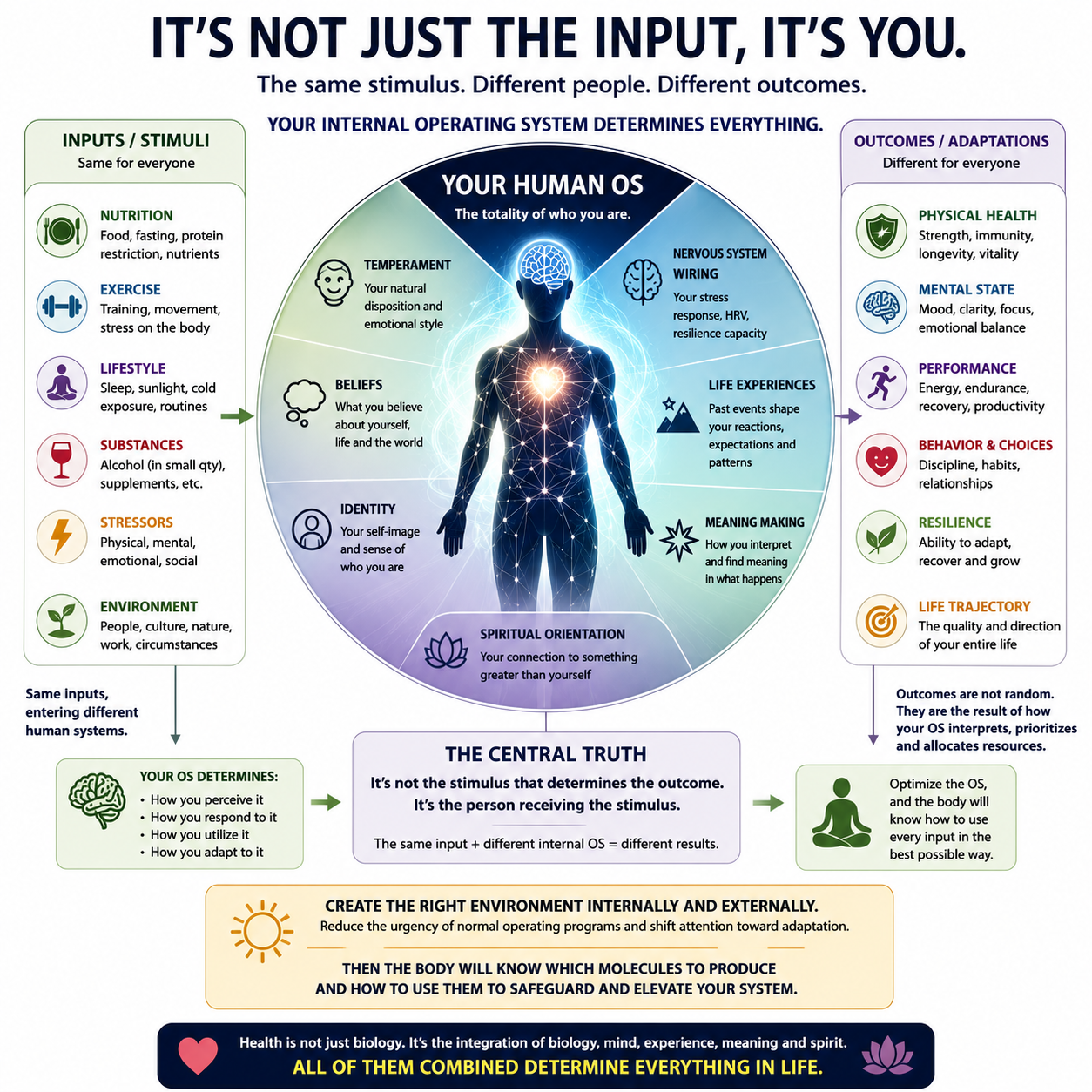
For most of my career, I have been fascinated by a simple question:
Why do two people exposed to the same thing often end up with completely different outcomes?
The same diet. The same exercise program. The same supplement. The same meditation practice. The same stressful event. The same life circumstances. Yet one person thrives while another struggles. Traditional health and performance models often focus on the input. We ask:
What should I eat?
What exercise should I do?
Which supplement should I take?
How many hours should I sleep?
What is the ideal protocol?
These are reasonable questions. But they may not be the most important ones. After decades of reading research, working with athletes, studying human performance, and observing real people in real environments, I have gradually shifted my attention elsewhere. The most important variable is often not the stimulus itself.
It is the person receiving the stimulus.
The Same Input, Different Outcome
Consider nutrition:
One person thrives on a high-protein diet. Another feels sluggish.
One person performs exceptionally well while fasting. Another experiences fatigue and poor recovery.
One person drinks alcohol occasionally and appears unaffected. Another develops metabolic dysfunction.
The input is similar. The outcome is not. The same pattern appears everywhere.
Exercise strengthens one person and injures another.
Cold exposure energizes one person and overwhelms another.
Stress motivates one person and breaks another.
Even success itself can create confidence in one person and anxiety in another.
Clearly, something exists between the stimulus and the outcome. That “something” is what I call the Human Operating System.
Your Human OS
Every human being arrives at a situation carrying a unique internal architecture.
This architecture includes:
- Temperament
- Nervous system wiring
- Beliefs
- Identity
- Life experiences, history, background
- Meaning making
- Spiritual orientation
Together, these factors determine how we perceive reality, interpret events, allocate resources, and adapt. Two people can experience the same event while effectively living through two different realities.
Biology Does not Operate in Isolation
Modern health discussions often reduce everything to molecules.
Dopamine.
Cortisol.
Testosterone.
Serotonin.
Insulin.
These molecules matter. But molecules do not appear randomly. The body continuously produces and utilizes them according to the demands it perceives.
The nervous system is constantly asking:
Is this safe?
Is this dangerous?
Should I grow?
Should I defend?
Should I conserve?
Should I engage?
Should I withdraw?
The answers to those questions are not determined solely by external events. They are heavily influenced by the Human OS.
This is why chasing individual molecules often becomes a dead end. People become obsessed with increasing dopamine, boosting testosterone, lowering cortisol, raising growth hormone, or enhancing some other biomarker. But if the operating system remains unchanged, the effect is often temporary.
The chemistry follows the interpretation.
The Missing Layer in Health and Performance
When people discuss health, they often focus on three visible areas:
Nutrition.
Exercise.
Lifestyle.
These are important. But there is another layer underneath them. A person’s beliefs influence compliance.
Identity influences behaviour.
Life experiences influence expectations.
Temperament influences stress responses.
Meaning making influences resilience.
Spiritual orientation influences purpose.
These invisible factors often determine whether a strategy succeeds or fails. The intervention may not be the limitation. The operating system may be.
The Central Truth
The above poster summarises the idea in one sentence:
It is not the stimulus that determines the outcome. It is the person receiving the stimulus.
The same input entering different human systems creates different results. This does not mean biology is unimportant. It means biology is part of a larger system. Health is not just physiology as considered by most influencers who are chasing protocols for dopamine hike. Performance is not just fitness either as followed by protein enthusiasts. Longevity is not just biomarkers as told by longevity experts.
Human beings are integrated systems where biology, mind, experience, meaning, and spirit continuously interact.
A Different Way to Think
Perhaps the goal is not to find the perfect protocol. Perhaps the goal is to understand the system that will receive the protocol.
Instead of asking:
“What is the best diet?”
We may need to ask:
“How will my system respond to this diet?”
Instead of asking:
“What is the best training program?”
We may need to ask:
“What type of stress can my system currently adapt to?”
Instead of asking:
“Which molecule should I increase?”
We may need to ask:
“What conditions encourage my body to produce and use the right molecules?”
That shift changes everything. Because once you understand your operating system, you stop blindly chasing inputs. You start understanding yourself. And in the long run, that may be the most powerful intervention of all.

