
Some time back, I coined a phrase: “Cheat the mind.”
A quick note before we begin: When scientists use a placebo in clinical trials, they are, in my way of thinking – cheating the mind. The participant believes they have received a treatment, and that belief alone can trigger measurable physiological changes. However, this process is largely unconscious. The idea I explore in this article is slightly different:
Can we consciously leverage similar principles to influence behaviour, physiology, and performance by understanding how the brain responds to patterns and signals rather than objective magnitude?
Here’s how it goes:
Whenever we try to break an addiction and find it difficult, it is often because our subconscious mind, or what we may call our trained brain’s circuitry and memory, triggers a cascade of emotional responses that prompt us to seek the very thing we are trying to avoid.
I began experimenting with a simple question: Does the subconscious actually understand quantity? In other words, does it need a specific amount to feel satisfied, or is the amount largely irrelevant?
Whether it is alcohol, smoking, junk food, social media, television, repeatedly checking the phone, or any other habit, addictions operate through a similar mechanism. Repetitive behaviours become embedded in our neural circuitry, and over time the brain keeps reminding us of them.
What I observed was interesting. The subconscious mind does not seem to keep a precise account of quantity or duration. If you have a habit of checking your phone every few minutes, simply picking up the phone may satisfy the circuitry. The brain is not particularly concerned about whether there is actually a new notification waiting. After all, very little changes within a minute.
Likewise, if you drink alcohol every day and are accustomed to four pegs, the mind does not necessarily distinguish whether those pegs are 30 ml or 60 ml. The same applies to smoking. The circuitry seems more concerned with lighting the cigarette than whether you consume 70% of it or finish it completely.
My “cheat the mind” philosophy was built on this premise.
Experiments: Using this approach, I not only reduced my own alcohol, tea, or coffee intake but also helped many others reduce theirs. A few individuals who spent extended periods with me later admitted that they never realised how much they had cut down. They consumed significantly less while still feeling that they had enjoyed their drink. In one case, I had to literally sell the concept of enjoying the taste of tea to make someone quit the habit of having biscuits with tea 🙂
Lets us now understand where science and spirituality meets in the context
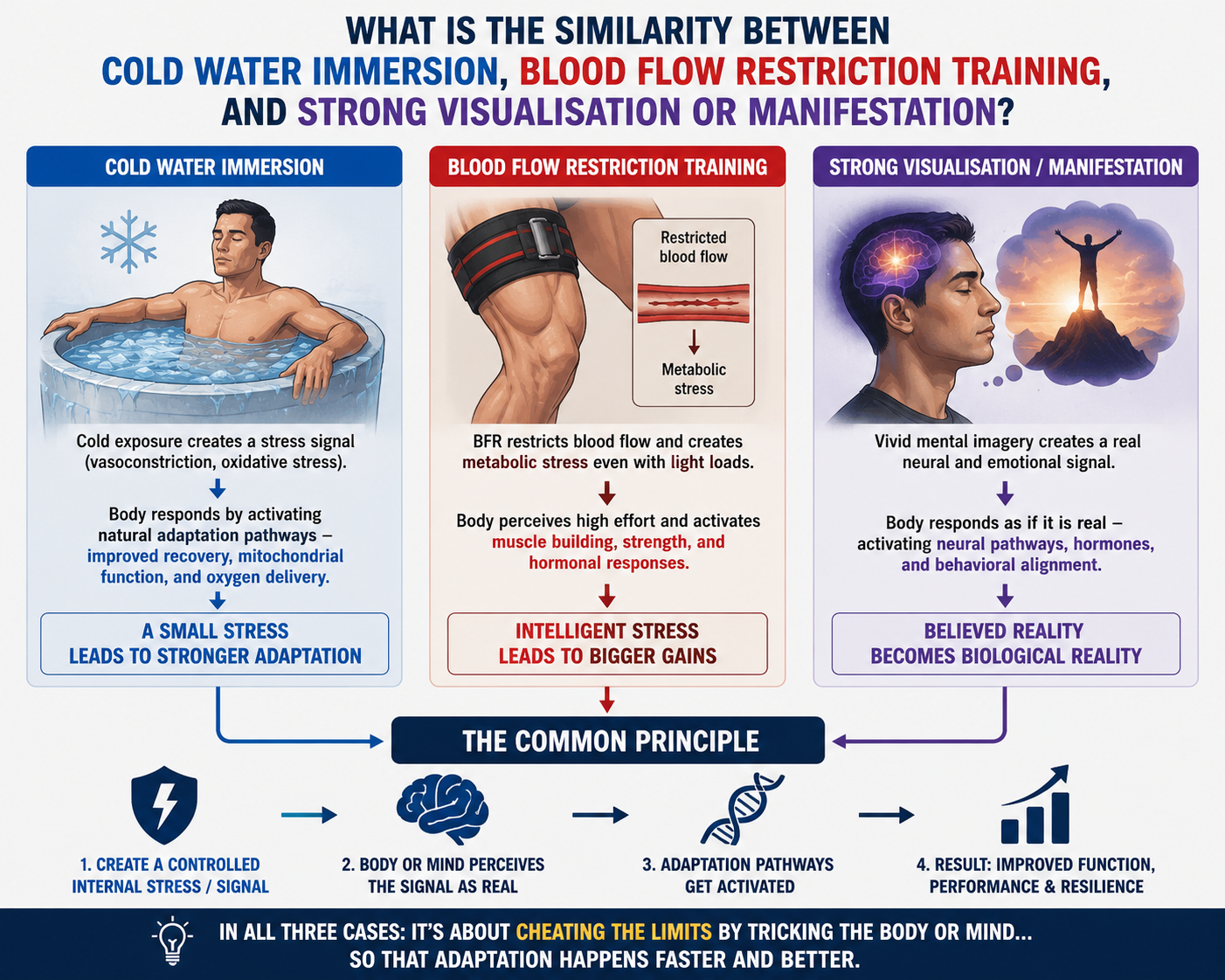
1) Blood Flow Restriction (BFR) training appears to be doing something remarkably similar to cheating the mind.
By partially restricting blood flow while exercising with relatively light loads, the body generates many of the same signals normally associated with much heavier training. Despite using far less weight and placing less stress on the joints, several of the pathways linked to muscle growth and adaptation are still activated. In a sense, the brain and body interpret the situation as a much greater physical challenge than it actually is. The resulting physiological response resembles what would normally occur under heavier loads.
Again, the system is, in a way, cheating the mind and eliciting a response that would ordinarily require a completely different situation.
2) Cold Water Immersion (CWI): Interestingly, I recently found myself thinking about a completely different intervention:
When we step into cold water, blood vessels constrict, stress hormones rise, and the body rapidly shifts into a survival mode. The cold itself is real, but the physiological response is often far greater than the actual threat. The body interprets the signal as a challenge and begins activating pathways related to adaptation, resilience, and recovery. In its own way, Cold Water Immersion also appears to be creating a powerful signal that the body responds to.
This led me to a broader question.
What do Cold Water Immersion, Blood Flow Restriction training, and powerful visualisation or manifestation have in common?
Consider a simple example:
It is a beautiful monsoon morning in Delhi. A couple sits on their balcony watching the rain. The husband is on holiday. He is lost in the moment, already thinking about another cup of coffee and something special to eat. The wife has to get to work. She is calculating how late she will be and how wet she is going to get.
Same rain.
Same balcony.
Completely different brain activity.
Now replace the rain with something we deliberately create in above examples:
- Blood Flow Restriction training restricts blood flow while lifting relatively light loads. The body interprets the situation as a much greater physical demand and activates many of the same pathways associated with heavier training.
- Cold Water Immersion exposes the body to cold after training. Altered blood flow, temperature, and cellular stress signals create an environment that the body interprets as a challenge, triggering adaptation and survival pathways.
- Strong visualisation or manifestation creates a vivid internal experience. Neural circuits activate in ways that resemble the experience itself, helping shape behaviour, emotion, attention, and performance.
In each case, we create a real biological response through an engineered signal.
The brain does not respond to reality alone. It responds to the meaning and pattern of the information it receives. I call this Cheat the Mind.
The principle is simple: create the right signal, and the system begins adapting before the full reality arrives.
Let’s connect all this to spirituality.
The above theories and science essentially explains three of the most common commandments found across spirituality, religion, and philosophy.
- Command the Mind: The rain did not create the wife’s stress. Her thoughts about traffic, being late, and future consequences did. The first lesson is to become the master of the mind rather than its servant.
2) Live in the Present: The husband was experiencing the rain. The wife was experiencing a future that had not yet happened. Living in the present simply means returning attention to what is actually happening now.
3) Detachment: Detachment can be explained in many ways. However, given the context, detachment is not getting emotionally attached to outcomes that exist only as mental projections. You still go to work, but you do not suffer twice: once in imagination and once in reality.
Perhaps spirituality, at its deepest level, is simply the art of preventing the mind from mistaking imagination for reality.
Throughout my book, I explore many such associations, showing how seemingly unrelated phenomena often reveal a deeper interconnectedness when viewed through a holistic lens.

