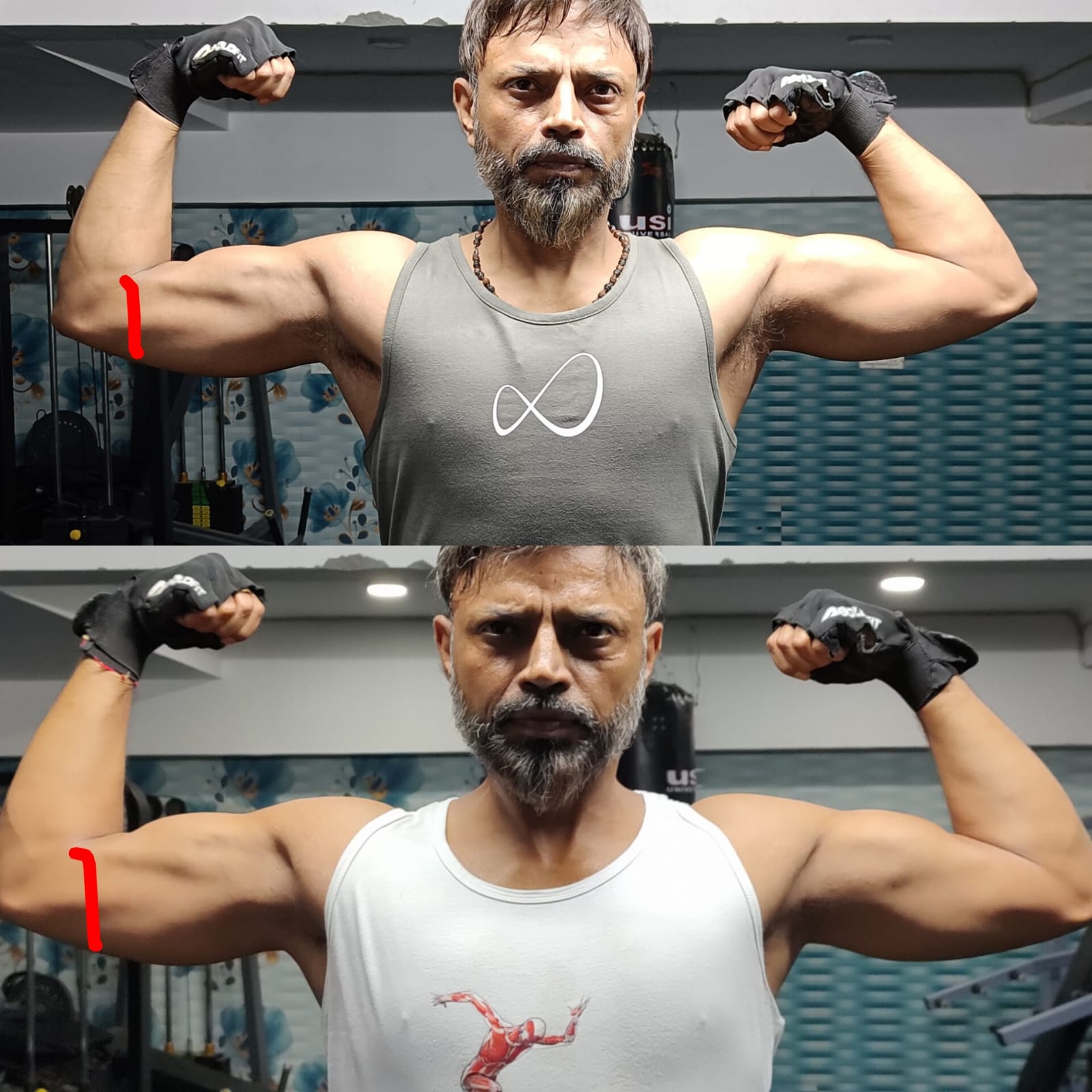
Ques: What happened when I dropped whey and creatine?
Ans: Nothing.
My muscle mass not only stayed the same, my lean tissue actually increased as it seems. The increase it seems is because of the break which I will discuss in a separate article.
I finished my last box of creatine a couple of months ago. Since I have never been a regular consumer of supplements, creatine was no exception. I am 52 and have probably consumed only five or six small boxes in my entire lifetime.
This time, however, I wanted to run a small experiment on myself and see whether it made any real difference. I added another variable as well.
For three weeks, while conducting a camp with sportsmen, I practically stopped training. I did only two very light 20 to 30 minute sessions during the entire period. In effect, it was three weeks without meaningful training.
- I had already stopped creatine three weeks before this break and never bothered to buy it again.
- More interestingly, I also stopped whey protein, which had been a regular part of my diet for years.
Note: It is important to mention that I was never taking whey for muscle building. My appetite has always been relatively low and whey simply helped me make up for the calories and protein I might otherwise miss. Always liked it as a small meal or snack.

I returned home on 7 June and got back to the gym on 8 June.
FOOD: During those three weeks, I was eating wholesome Indian meals. Every morning started with paranthas, and lunch and dinner usually included tandoori rotis. Tandoori roti is my weakness and, despite trying, I have never been able to skip it.
At home, I normally eat roti once a day and rice at dinner. During these 21 days, I was eating wheat in all three meals. Many would expect weight gain after three weeks of what some people would call a carbohydrate overload. I never did.
BURN: I knew I was burning enough energy through long working days, warming up the athletes, delivering lectures, and conducting evening recovery and relaxation sessions.
The picture below is from 16 June.
By then, I had completed just two biceps sessions after returning home. Only two sessions. Yet the results showed that I had not only maintained muscle mass but increased lean tissue.
No, this was not a water retention effect. I understand that argument. Nor was it the result of unusually hard or excessive training. I simply returned to my normal routine and the results were there for everyone to see.
What makes this even more interesting is the absence of whey protein.
To compensate for the calories that normally came from one and a half scoops of whey, I added fruits, high protein muesli with milk (although I am not convinced its good!), and occasionally other foods. Also worth mentioning is that I never consumed whey when I was not training. Throughout my life, I have regularly taken breaks from gym training, sometimes for months at a time while working on assignments.
Here are a few practical lessons that no laboratory can teach you:
- If you are eating a reasonable amount of food, which most people are, you do not need whey protein even if you train regularly in the gym.
- Whey may be useful when you are starting resistance training because it increases the available protein pool and may help maximise protein synthesis. But it is not a compulsion.
- The same applies to creatine. It may provide some benefit when you are starting out, but if you have been training consistently for years, it is far less important than people make it out to be.

A few things to remember:
a) Training history matters. If you are well trained, these things make far less difference than most people believe. The human body does not suddenly lose its foundation because training is interrupted for a few weeks.
b) Supplementation is a choice, not a necessity. Do not blindly follow research headlines. Studies are conducted under specific conditions, on specific populations, and within specific contexts. Their findings are not automatically applicable to everyone. Do not let influencers make decisions for you.
c) There is no need for extra protein unless you are a professional bodybuilder or pursuing exceptional muscular size in the shortest possible time. If your goal is fitness, health, and longevity, regular food is usually enough.
d) There is also no need to chase every high protein food trend. Whether it is black peas, channa dal, or the latest recommendation from social media, remember the principle above: most people already get enough protein from their normal diet.
Why does this observation matter for common people?
Because I am not only an expert in this field, I have also been a long term consumer of whey protein myself. And I am in good health. The results were observed on a body that is already highly trained and in peak condition. After removing both whey and creatine, reducing training for three weeks, and returning to normal eating, I still maintained muscle and increased lean tissue.
That does not mean supplements never work. They certainly have a place and I would still recommend them when genuinely needed.
What it does mean is that supplementation is not a requirement. It is an option.
Food remains the foundation.