
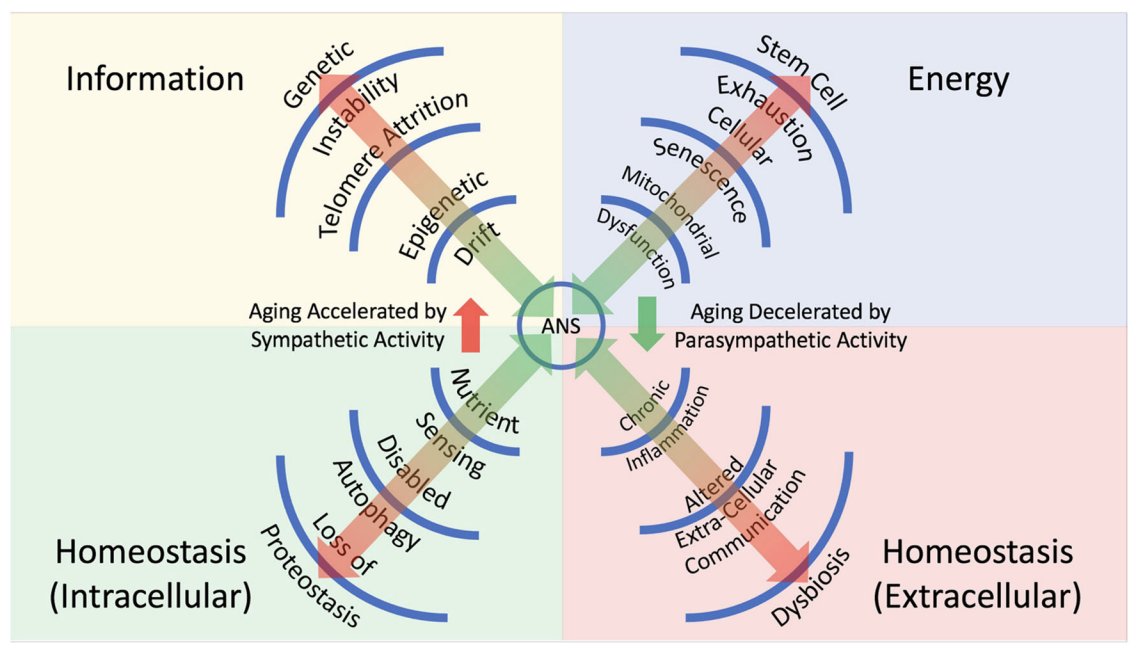
Research: https://www.nature.com/articles/s41514-025-00293-2
Research conclusion: Most aging theories focus on specific mechanisms—mitochondrial dysfunction, telomere attrition, chronic inflammation. But a new paper in npj Aging proposes that these aren’t independent processes. They’re downstream consequences of a single upstream imbalance. The autonomic nervous system has two opposing branches: the sympathetic nervous system (SNS), which drives the fight-or-flight response, and the parasympathetic nervous system (PNS), which activates rest-and-repair mechanisms.
Ques: How does it relate to mind?
Well shuttling between SNS and PNS is the work of our mind.
I agree with the research 100%.
To me, this is another example of why mouse studies do not always translate well to humans. The mind plays a huge role in maintaining the balance between the sympathetic nervous system (SNS) and the parasympathetic nervous system (PNS), and it works both ways. The research may make it sound as though staying in the PNS is the key. However, the SNS is equally important. The real power lies in a dynamic, responsive balance and the ability to cycle efficiently between challenge (SNS) and repair (PNS).
Note: The imbalance between SNS and PNS may also help explain why monks do not necessarily remain healthier as they age. Spending excessive time in one state, even a parasympathetic-dominant one, may not be ideal. The key appears to be balance and the ability to move fluidly between challenge and recovery.
It also supports my theory of aging:
“aging occurs when the system goes out of sync between insult and repair, when the accumulated damage exceeds what our physiology can heal.” – by UC
Every system in the body is designed to respond to challenges through neurotransmitters such as norepinephrine, epinephrine, dopamine, and others. However, this response must remain balanced. Keeping these neurotransmitters chronically activated can have downstream effects on metabolism, energy, restlessness, recovery, and overall function.
This balance is restored by the PNS. A mouse can remain in a SNS/PNS state if its environment allows it. Humans, however, must also contend with the mind. Thoughts, anticipation, worry, memory, and perception continuously influence physiology, making the human response fundamentally different.
This is exactly why I positioned the Mind as one of the four foundational pillars in my book Wiring to Wisdom – a guide to Human OS. Research like this doesn’t just confirm the narrative, it validates the underlying reasoning I laid out in my book.
Here is a chapter that explains the book:

