
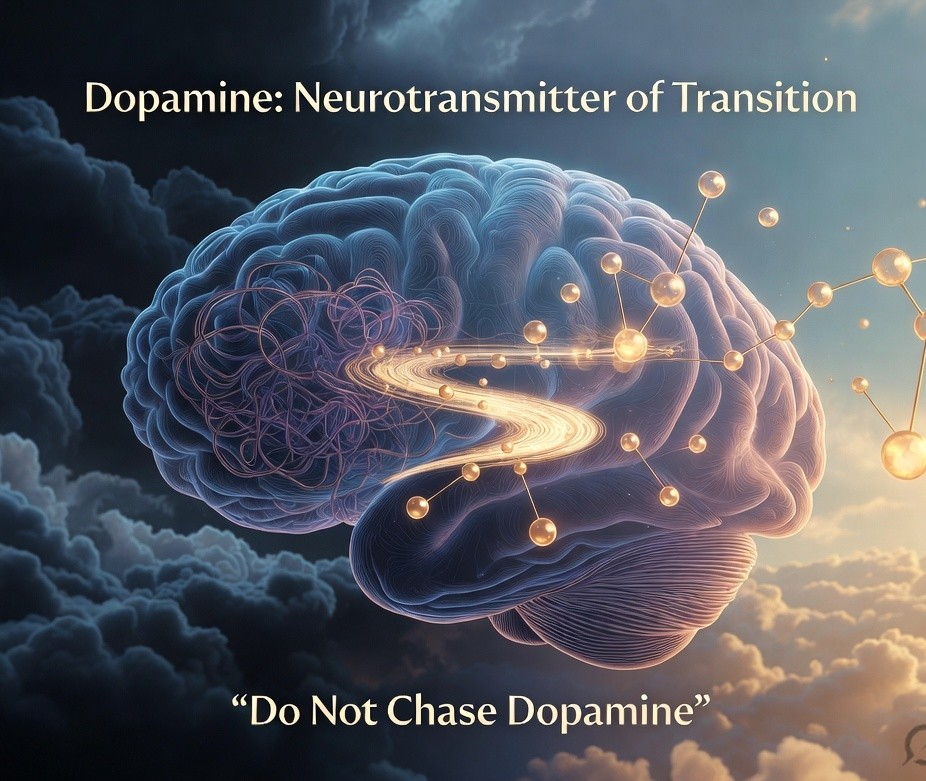
Dopamine: The Neurotransmitter of Transition, Not Pleasure
Modern neuroscience often describes dopamine as a neurotransmitter associated with reward, motivation, anticipation, novelty, and pursuit. Popular culture and many high-profile voices in the space has simplified this even further by calling it the “pleasure chemical” and urging people to chase higher levels through cold baths, supplements, habits, or hacks.
This framing is misleading and potentially counterproductive in my view.
Several observations challenge the dominant narrative:
- Meditation practitioners often show increased dopaminergic activity despite deliberately reducing pursuit of pleasure, novelty, food, status, or excitement.
- Individuals using marijuana frequently become quiet and introspective rather than euphoric.
- People emerging from psychological distress often seek relief long before they seek pleasure.
These point to a deeper truth or a question: Is Dopamine is not primarily a neurotransmitter of pleasure? Or it is a neurotransmitter of transition.
The Problem with Measuring States Instead of Processes
Most studies measure neurotransmitters at a single point in time and correlate them with current emotional states. This misses how human experience unfolds as a process.
Consider someone under psychological stress: repetitive thoughts, fixed attention on problems, reduced emotional flexibility. When relief finally arrives, researchers might see lower cortisol, higher GABA, and calmer brain activity. But those snapshots don’t reveal how the transition happened. The destination is visible. The journey and dopamine’s role in facilitating it, is not.
Relief Comes Before Pleasure
Under real distress, people rarely chase excitement or pleasure first. They want the mental burden to lift. The natural sequence is usually:
Stress – Relief – Contentment – Pleasure (optional..depends on situation)
The first goal is freedom from conflict, not happiness. The neurobiology of relief and resolution differs from the neurobiology of hedonic pleasure. Dopamine appears to play a central role in enabling that shift from uncertainty to clarity, from rumination to resolution, from distress to relief.
The Meditation Puzzle
Meditation further complicates the pleasure/reward model. Practices that reduce external stimulation, goal pursuit, novelty, and behavioral output can still increase dopamine release. This dopamine surge occurs alongside reduced default mode network activity, increased GABA, and stronger parasympathetic tone. It is not about chasing rewards, it is about resolving internal conflict and shifting mental states.
Cold Exposure: A Case Study in Misguided Dopamine Chasing
Popular protocols (ice baths or cold plunges) are often sold as reliable dopamine boosters. Lab data shows acute spikes in plasma dopamine and norepinephrine during cold immersion. Yet this is a classic example of over extrapolating from controlled physiology to messy real life.
- These spikes are part of a broad stress response, not a clean – motivation upgrade.
- Plasma levels do not reliably translate to the brain’s key dopamine pathways involved in motivation and state transitions.
- Personal experience and observation tell a different story: athletes recovering from intense effort never emerged fresh and enthusiastic in my live team environments. The result is often alertness mixed with lingering discomfort, not sustained drive or positivity. These athletes still looked quiet, calm, and tired. It’s the time of the day (after play) that determines their behaviour and not dopamine!
Therefore chasing dopamine through cold exposure illustrates the deeper flaw: dopamine is highly state-dependent and mind-driven. The same physiological trigger produces wildly different outcomes depending on your current mental state, expectations, fatigue level, and framing. When your system is already overloaded, forcing a dopamine spike via discomfort often fails to deliver meaningful transition or benefit.
A Different View of Dopamine
Would I be wrong if I say Dopamine is not the neurotransmitter of pleasure and instead, it is the neurotransmitter that helps the brain move between states -confusion toward understanding, conflict toward resolution, distress toward relief, disengagement toward engagement.
Pleasure can be one downstream outcome, but dopamine cannot be the primary driver clearly. The real “reward” is often the reduction of internal conflict itself in many states where dopamine is found to be higher.
Do Not Chase Dopamine
This leads to the practical takeaway: Stop trying to directly increase dopamine.
Dopamine is largely an after-effect of your thinking processes, attentional habits, and how you navigate mental states. It responds to the quality of your internal transitions more than to external hacks.
- When you resolve uncertainty through clear thinking, dopamine supports that shift.
- When you reduce rumination and create mental space (as in meditation), dopamine participates in the resulting calm focus.
- When you pursue meaningful goals aligned with your values, dopamine reinforces the process not because you chased the chemical, but because the mind led the way.
The question should be:
“What role does dopamine play while I move from suffering toward peace and how can I improve the quality of that transition through better thinking and awareness?”
GABA, serotonin, the endocannabinoid system, parasympathetic regulation, and many other mechanisms all contribute. Dopamine is a key facilitator, but it is not the master switch as it is projected to be.
Focus on the process: cultivate mental clarity, resolve internal conflicts, train attention, and create conditions for natural state shifts. Dopamine will follow as a supportive after-effect not as the goal.
This perspective moves us beyond pop-science hype toward something more useful: understanding and working with the mind itself.
Note: If conditioned cues are indeed the primary triggers for dopamine release, then an interesting question emerges in the context of meditation.
Could mental peace itself become a conditioned cue?
For an experienced meditator, the expectation of calmness, silence, or inner peace may act as a reward-predicting signal. If so, the anticipation of that state could trigger dopamine release, motivating the individual to sit for meditation.
Following the conventional dopamine framework, one could then hypothesize the following sequence:
Conditioned cue: Expectation of mental peace and calmness
Leads to: Initiation of meditation practice
Followed by: A decline in dopamine below baseline, creating a drive or craving for the anticipated state
Resulting in: The eventual experience of calmness and mental peace
However, this raises a deeper question:
If meditation is fundamentally driven by a dopamine-mediated craving for calmness, then how do we explain the observation that long-term meditation practitioners often report reduced craving, reduced seeking, and greater contentment?
Is meditation simply another reward-seeking behavior with a different reward, or does it represent a process that gradually transcends the very craving mechanisms that dopamine theories are often used to explain?
The answer may reveal whether dopamine is the central driver of meditation or merely one component of a much broader regulatory process occurring within the nervous system.

