
I plan to write four articles, covering each of the four paths of Yoga.
I would not just draw from the philosophy and explain it. I would make an effort to put each path into a modern context and explore why it is important for human beings to understand it – perhaps more relevant today than ever before.
Note: This is not a guru’s philosophy. It is a discussion. Feel free to engage, question, disagree and present your own view.
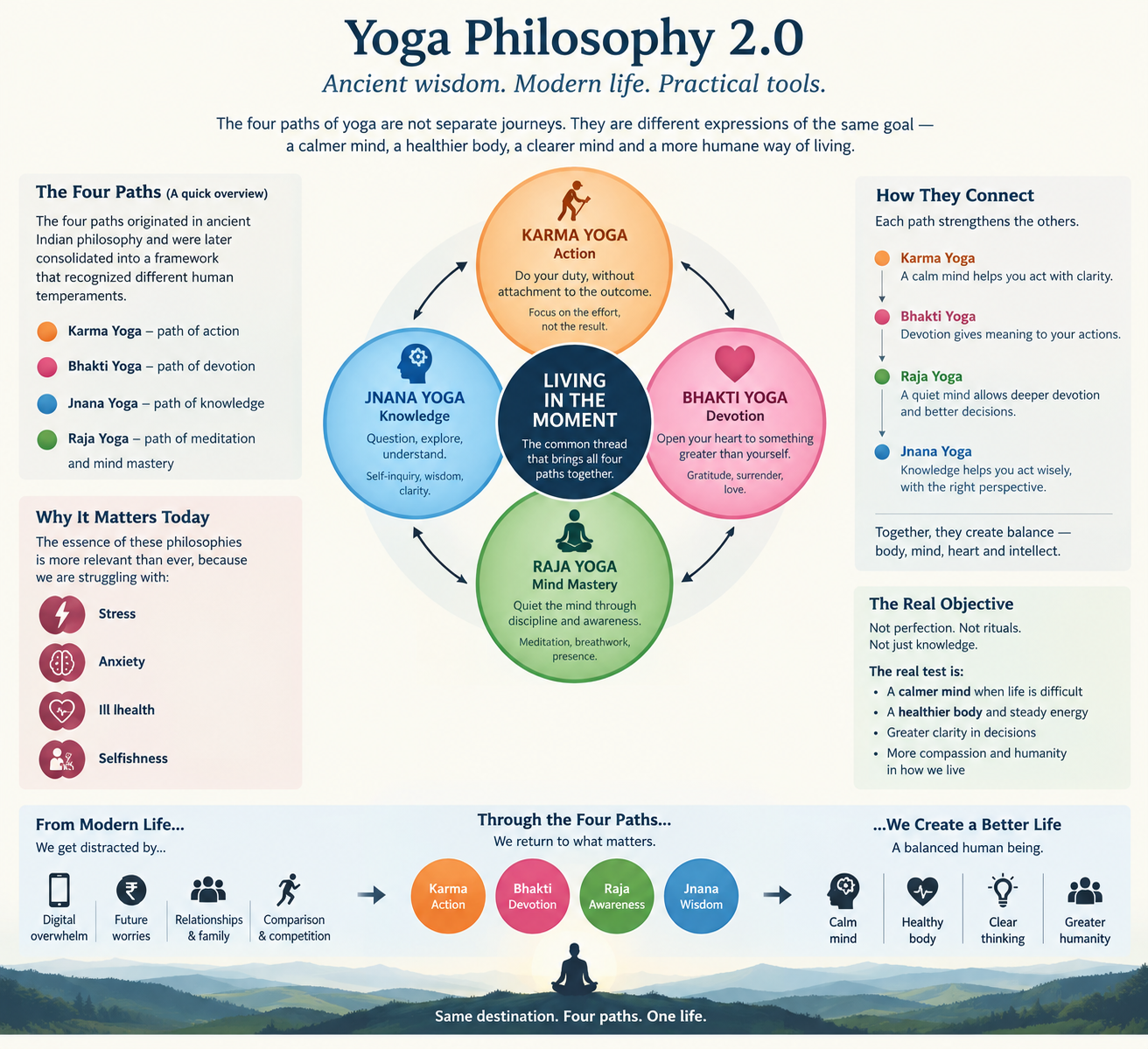
Yoga Philosophy 2.0
The four paths of Yoga: Karma, Bhakti, Jnana, and Raja – grew out of ancient Indian thought and were later organised as a map of human temperament. Some people are built for action, some for feeling, some for inquiry, some for inner discipline. The paths are not four religions. They are four ways of using the same mind.
This is not a claim that Yoga Philosophy is superior to every other tradition. It is a claim that it is complete. Most serious philosophies of the world find a home here: how to act, how to love, how to know, and how to still the mind. Yoga Philosophy 2.0 exists to show that completeness in a language the present century can use.
Traditionally:
- Karma Yoga – the path of action
- Bhakti Yoga – the path of devotion
- Jnana Yoga – the path of knowledge
- Raja Yoga – the path of meditation and mastery of the mind
For centuries these ideas pointed people toward a quieter, more useful life. Their age is not what matters. Their accuracy is. They describe how the mind actually works, which is why they fit today’s crowded, anxious century better than they fit a slower one.
The problem is not that the teachings disappeared. It is that their essence thinned out.
- We act, but stay chained to the result.
- We practise devotion, but shrink it into ritual.
- We collect information, but rarely convert it into wisdom.
- We sit to meditate, but treat the sitting as a timed task instead of a way of living.
So, despite more comfort and more knowledge than any previous generation, four problems dominate ordinary life: stress, anxiety, ill health, and selfishness.
Let us look at the four paths again, without the costume.
Karma Yoga The Problem of Stress
Most people believe stress comes from work. It does not. Stress comes from living in a future that has not arrived, from carrying imagined problems as if they were already real, and from trying to solve questions that are beyond our present capacity.
This does not mean ambition is a mistake. To be human is to live toward outcomes. A life with no aim is not spiritual; it is unfinished. Karma Yoga never asked anyone to stop wanting success, money, excellence, or a better future. It does not question the destination. It questions the place from which you travel.
There is a second half to this path, and it is often left out. Karma Yoga is not only action without agitation. It is action that is not built only around the self. Work done only to inflate “me” keeps the mind in comparison and hunger. Work that includes others – usefulness, fairness, help given without expectations quiets that hunger. Selfishness is not corrected by dwelling on the past, nor by speeches about the future. It is corrected through the work you are doing now – who it serves, why you are doing it, and whether you are willing to put the larger good before yourself.
Selflessness is not an idea to preach. It is something you practise in the way you live, work and serve. Every minute with everybody.
The overlooked point is this: the result may lie in the future, but the only place where you can create it is in the present. You cannot arrive at next year by living in next year. You arrive by doing today’s task with a clear mind.
That sounds like common sense. It is. It is also hard, because the mind tends to treat the result as more real than the action that creates it.
Analogy: ignoring your health today while imagining a happy and healthy future is self-contradictory. If you understand Karma Yoga, you begin to think differently. You would say: I can build a happier future only by taking care of my health today. The future is created by what you do in the present. Only then do you truly understand why health is wealth.
The problem is not merely “thinking about the future.” The problem is that attention is energy. When that energy leaves the work and enters rehearsal, worry, and comparison, the body follows. People may not know the Gita. They know cortisol. Same effort, wrong channel: the fuel that could have built the result is burnt as stress.
You may decide to become excellent. You may even use rivalry as fuel. What does not work is competing, in thought, with a person who is already standing where you have not yet arrived. That comparison produces only jealousy and a false sense of inferiority. It does not produce skill.
You can work extremely hard and still remain calm.
You can be ambitious and still be healthy.
You can pursue excellence and still sleep.
The practical test is simple: what is in your control, and what is not? Effort, attention, preparation, honesty- these are yours. Markets, other people’s decisions, timing, destiny, luck – these are not. Karma Yoga is the habit of putting full attention on the first list. The mind will still wander into the second. The practice is noticing that, and coming back.
The essence is not the absence of desire. It is the ability to give the work in front of you your whole mind because that is the only place from which the result can actually be built – and then to let the mind leave the work when the work is done.
A short modern picture: many people lift more than you, eat more carefully than you, and still look rounded rather than shaped. The missing piece is not always fat. It is placement. A three-headed muscle like the deltoid becomes a lump when the work meant for the shoulder is leaked into chest presses and pulldowns. The gym is busy. The anatomy is not. Form is attention landing on the exact fibre you mean to train.
Work is the same. Serious people already work hard. The leak is the point. When the energy of effort is scattered into tomorrow, into comparison, into problems you cannot yet solve, the same labour produces more stress than satisfaction and then the body pays the bill.
That discipline is Karma Yoga in modern life.

