
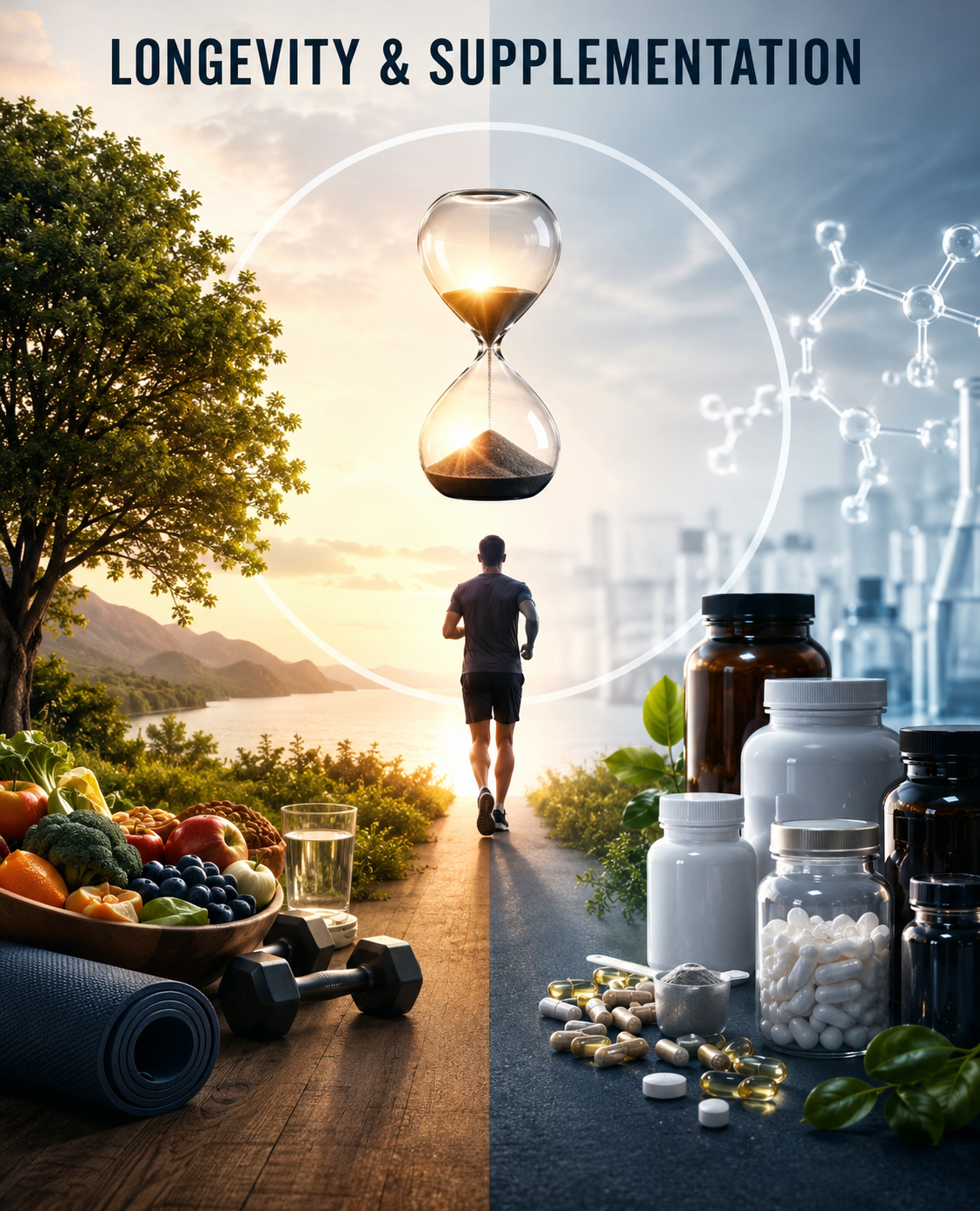
“The absence of large numbers of healthy, high-functioning centenarians may be one of the strongest real-world arguments against claims that major lifespan extension is already within reach.”
Longevity is one of the hottest topics in the world today. My concern is that many people discussing it are not from a scientific background, making it easy to be drawn in by attractive promises. A single sentence can make you believe that you can live longer, stay healthy forever, and do it all without meaningful compromises.
The primary purpose of supplementation is to correct a deficiency and restore normal physiological function. That is very different from dramatically extending human lifespan as projected by a few experts.
Ex: Vitamin D may offer no benefit and can even have negative effects when given to people who do not need it. The same principle broadly applies across human physiology. More is not always better.
Our bodies operate through balance. We can influence certain levers and improve specific functions, but every biological system exists within a network of trade offs and compensations. There is no free lunch in biology.
Improving healthspan can absolutely increase lifespan. Helping someone reach 80 or 90 in good health instead of 60 or 70 is a remarkable achievement. I fully believe this is possible and worth pursuing. What concerns me is when the discussion shifts from improving health to suggesting that humans should routinely live to 120, 150, or beyond.
Aging affects multiple systems simultaneously:
• Muscle protein synthesis and muscle function
• Cognitive function
• Glucose metabolism
• Fat metabolism
• Joint and connective tissue health
• Visual function
• Cardiovascular function
• Mitochondrial function
• Immune function
• Bone health
• Hormonal function
• Nervous system function
• Heart health
The foundation for maintaining these systems remains remarkably simple:
“Move well. Stay active. Eat good food.”
If someone is deficient in a nutrient, by all means supplement. But correcting a deficiency is not the same as extending lifespan. It simply restores what was missing. Even when we do everything right, these systems continue to age. We become slower. Recovery takes longer. That is not failure. It is biology.
Modern medicine can prevent disease, restore vision, improve hearing, and reduce the burden of many age related conditions but doesn’t change the upper limits of human lifespan. If it were, we would already see large populations of healthy centenarians jogging, driving, working, and functioning like people decades younger. We do not. Frailty remains common. No culture, population, or region has demonstrated a reliable way to substantially extend maximum human lifespan.
From my perspective, helping more people reach 90 or even 100 in good health is a realistic and exciting goal. Better healthspans can lead to somewhat longer lives.
Helping humans routinely reach 120 to 150 years remains, at least today, more aspiration than evidence.
The pursuit of healthspan is science. The promise of extreme lifespan extension is, for now, a hypothesis. And those two should not be confused.

