
Original Research Paper: Impact of physical activity on physical function, mitochondrial energetics, ROS production, and Ca²⁺ handling across the adult lifespan in men — Cell Reports Medicine, 2025
1. What happens to our mitochondria as we age?
We often hear that ageing is associated with declining mitochondrial function, reduced ATP production and increased oxidative stress. These changes are frequently presented as major contributors to muscle deterioration and the loss of physical capacity. But is this necessarily what happens when we remain physically active?
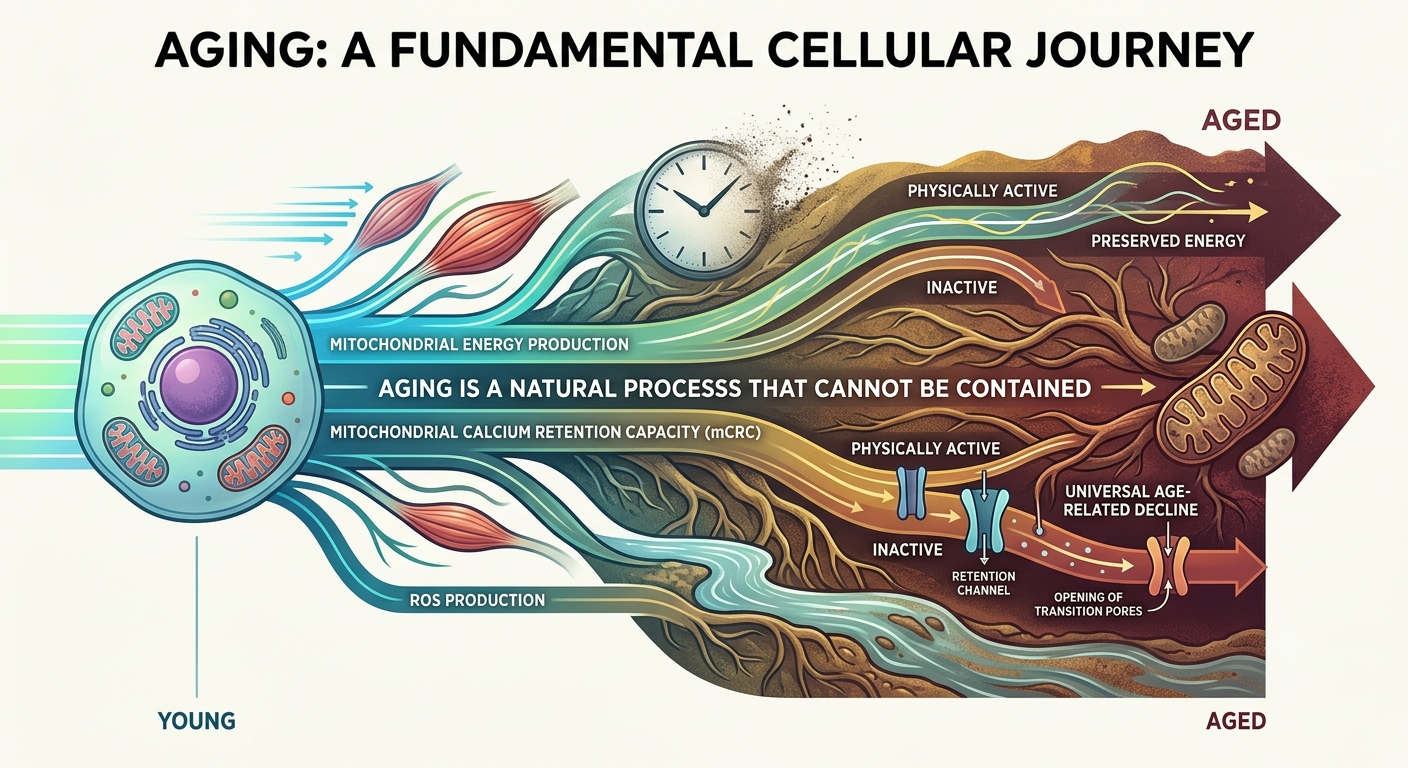
A particularly interesting 2025 study by Cefis and colleagues examined mitochondrial function across the adult lifespan, comparing physically active and inactive men. The researchers studied 139 men between 20 and 93 years of age, assessing mitochondrial respiration, reactive oxygen species (ROS) production, calcium-handling capacity, muscle characteristics and physical performance. The findings challenge some conventional assumptions about mitochondrial ageing.
Three observations stand out:
- Mitochondrial respiratory capacity was relatively preserved in physically active men, with no significant age-related decline.
- Mitochondrial ROS production did not increase significantly with age, irrespective of physical activity status.
- Mitochondrial calcium retention capacity declined with age, regardless of whether individuals were physically active or inactive.
The third finding is particularly interesting. It suggests that some mitochondrial functions can remain relatively well preserved with physical activity, while others continue to deteriorate with age. This distinction deserves considerably more attention.
2. What physical activity preserved – and what it could not: tet’s look at the findings more closely.
Mitochondrial energy production
Physically active men maintained mitochondrial respiratory capacity across the age groups studied.
Inactive individuals showed a tendency towards declining respiratory capacity.
Physical activity was also associated with greater mitochondrial respiratory capacity.
This suggests that the decline in mitochondrial energy-producing capacity commonly attributed to ageing may, at least partly, be a consequence of reduced physical activity rather than ageing itself.
Note: This finding is important to show why exercising and staying active is important as we age.
Reactive oxygen species
The researchers found no significant age-related increase in mitochondrial hydrogen peroxide emission, a commonly used indicator of mitochondrial ROS production. Interestingly, physically active participants showed higher ROS emission than inactive participants. This was likely related to their greater mitochondrial content rather than increased intrinsic oxidative stress. There was also no negative association between ROS production and muscle mass, strength or physical performance.
This challenges the simplistic assumption that more mitochondrial ROS necessarily means faster muscle ageing.
Mitochondrial calcium regulation
Here comes the interesting part.
The researchers measured mitochondrial calcium retention capacity (mCRC). This represents how much calcium mitochondria can take up and retain before reaching the threshold associated with opening of the mitochondrial permeability transition pore (mPTP). They found that calcium retention capacity declined with age in both physically active and inactive men. Physical activity did not prevent this deterioration. The time taken for the permeability transition pore to open also decreased with age.
In other words, even physically active men experienced deterioration in this particular mitochondrial function.
NOTE: This is an important distinction: maintaining mitochondrial energy production does not necessarily mean maintaining all mitochondrial regulatory functions – or aging!!
3. The bigger question: If exercise cannot prevent everything, what can?
I find this aspect of the research particularly valuable. Physical activity is probably one of the most comprehensive physiological interventions available to us. It influences cardiovascular function, glucose regulation, mitochondrial adaptations, neuromuscular coordination, bone health, muscle quality and several cellular maintenance mechanisms.
Yet, even with these benefits, the study found that mitochondrial calcium retention capacity declined with age. Physical activity provided partial protection against the age-related decline in physical performance and helped preserve mitochondrial energetics, but it could not prevent every age-related cellular change.
This brings us to a much larger question about longevity?
There is an increasing tendency among longevity enthusiasts to look for a molecule, supplement or pharmaceutical intervention that can target an individual ageing pathway and potentially extend lifespan. But if regular physical activity, which influences multiple physiological systems simultaneously, cannot prevent every age-related deterioration, how realistic is it to expect a pill targeting one particular pathway to preserve the entire organism?
This is not an argument against pharmaceutical research. Targeting mitochondrial calcium handling or other ageing mechanisms may eventually produce useful therapeutic interventions. The issue is confusing improvement in an individual biomarker or cellular pathway with improvement in the health and functional capacity of the entire organism. A pill may improve one mechanism. But can it maintain the complex interaction between energy production, protein turnover, cellular repair, metabolic regulation, neuromuscular function and tissue maintenance?
That is a much bigger challenge. Perhaps we need to move away from the idea of finding one intervention that reverses ageing and instead understand how the organism maintains itself despite the deterioration of individual components.
MY 2 cents: There is a reason why none of our ancient texts talk about longevity!!
4. Why muscle becomes central to this discussion
The study also found that mitochondrial calcium retention capacity was positively associated with muscle mass, knee-extension strength, walking performance and other measures of physical function. This makes skeletal muscle particularly interesting. Muscle is not simply a tissue responsible for movement or physical appearance. It is a major metabolic tissue involved in glucose disposal, substrate utilisation, amino acid metabolism, mitochondrial activity and physiological adaptation. It also undergoes continuous protein synthesis, degradation, remodelling and repair.
Muscle contraction itself depends on tightly regulated calcium signalling. Mitochondria also participate in calcium regulation, connecting muscular activity with cellular metabolism and energy management.
Therefore, muscle health cannot be understood simply by measuring how much muscle we have. We need to consider its metabolic characteristics, mitochondrial function, intramuscular fat, contractile properties, neuromuscular control and capacity for repair. A person maintaining good muscle mass, strength and functional capacity into their 60s or 70s is maintaining much more than physical appearance. They are maintaining an important component of the body’s ability to regulate and sustain itself.
This brings me to MCMM.
5. MCMM: Maintenance-Compatible Muscle Mass
MCMM stands for Maintenance-Compatible Muscle Mass. The idea is simple: muscle mass should not be viewed as something that needs to be maximised continuously. It should be viewed in the context of the organism’s capacity to maintain it. Muscle is metabolically active tissue. Maintaining it requires energy production, protein synthesis, protein degradation, mitochondrial function and cellular repair. As we age, several systems involved in these processes change. These include anabolic signalling, neuromuscular function, hormonal regulation, mitochondrial quality control and protein turnover.
The idea is simple: muscle mass should not be viewed as something that needs to be maximised continuously. It should be viewed in the context of the organism’s capacity to maintain it.
Muscle is metabolically active tissue. Maintaining it requires energy production, protein synthesis, protein degradation, mitochondrial function and cellular repair.
As we age, several systems involved in these processes change. These include anabolic signalling, neuromuscular function, hormonal regulation, mitochondrial quality control and protein turnover.
Therefore, the objective should not necessarily be to keep accumulating muscle mass throughout life. It should be to maintain an optimal amount of functional muscle that the organism can effectively support. Too little muscle compromises physical capacity and metabolic health. But continuously pursuing additional muscle mass without considering the organism’s overall maintenance and repair capacity may not be the most sensible strategy either.
It should be to maintain an optimal amount of functional muscle that the organism can effectively support.
Too little muscle compromises physical capacity and metabolic health. But continuously pursuing additional muscle mass without considering the organism’s overall maintenance and repair capacity may not be the most sensible strategy either.
MCMM shifts the emphasis from muscle accumulation to muscle maintenance and quality. And this is where the calcium research becomes relevant.
And this is where the calcium research becomes relevant.
Even if we cannot prevent every age-related mitochondrial change, can we maintain sufficient muscle quality, metabolic capacity and functional reserve to reduce its consequences? That is a much more useful question than simply asking how much muscle we should build.
6. Balance Theory: Understanding the entire organism
My Balance Theory looks at health through the interaction of four important components:
- Energy production.
- Genome-to-ribosome signalling and protein production.
- Repair capacity.
- Maintenance-Compatible Muscle Mass (MCMM).
These components cannot be studied independently. Energy production without adequate repair capacity is insufficient. Protein synthesis without appropriate protein turnover and cellular maintenance is insufficient. Muscle mass without metabolic and functional quality is insufficient. Similarly, repair mechanisms cannot operate independently of the energy and regulatory systems that support them.
Similarly, repair mechanisms cannot operate independently of the energy and regulatory systems that support them.
The mitochondrial calcium research adds another important dimension to this framework.
It demonstrates that even when mitochondrial energy-producing capacity remains relatively preserved, another regulatory mechanism can deteriorate with age. This is precisely why I believe we need to look beyond individual biomarkers and individual metabolic pathways.
An organism may maintain one function while another deteriorates. It may also develop compensatory mechanisms that allow it to maintain overall physiological performance despite changes at the cellular level. The ability to produce energy and the ability to maintain cellular homeostasis are not necessarily the same thing.
Balance Theory attempts to bring these interconnected processes into one framework.
The objective is not to maximise every individual parameter. It is to maintain sufficient capacity across the entire system to produce energy, regulate cellular processes, synthesise and recycle proteins, repair damage and sustain functional tissues.
7. Exercise should be viewed differently
This research also changes how I look at exercise. We have traditionally prescribed exercise to improve cardiovascular fitness, increase energy expenditure, stimulate mitochondrial biogenesis, build muscle or improve energy production.
All these objectives have their place. But perhaps we should look at exercise more broadly: as a tool to provide appropriate physiological stimulation to different tissues and systems so that the organism can maintain its ability to manage itself. This means movement diversity rather than becoming overly attached to one particular exercise or training method.
Walking, resistance training, cycling, running, climbing, jumping and different forms of movement provide different mechanical, metabolic and neurological stimuli.
The objective is not to maximise one physiological adaptation at the expense of everything else. Heavy resistance training has its place. So does cardiovascular conditioning, lighter resistance work and regular movement throughout the day. Even short bouts of movement can influence metabolic responses. Research on breaking up prolonged sitting, for example, has demonstrated improvements in post-meal glucose and insulin responses.
We should therefore consider not just how much exercise we perform, but also how frequently we move, the variety of stimuli we provide and how well we recover and adapt. The goal is to maintain the entire system, not maximise one component.
8. What ageing research should investigate next
I think this study raises one particularly important research question.
If mitochondrial calcium retention capacity declines with age in both physically active and inactive men, what mechanisms allow physically active individuals to maintain better muscle characteristics, mitochondrial energetics and physical performance despite this deterioration? Are there differences in cytosolic calcium regulation, sarcoplasmic reticulum function, mitochondrial quality control, protein turnover, autophagy, neuromuscular integrity or cellular repair?
And could these mechanisms explain why two individuals experiencing similar age-related cellular changes can have very different functional outcomes? The present study cannot answer these questions. It was cross-sectional and did not establish the mechanisms responsible for the relative preservation of physical function.
But this is where I believe future research should focus.
We need to understand not just what deteriorates with age, but also what allows some individuals to maintain physiological function despite that deterioration. – and it most definitely wont be a supplement coming out of a longevity scientist lab.
9. The conclusion: Maintain the organism, not just individual components
We have spent decades discussing how to improve mitochondrial energy production, increase muscle mass, maximise protein synthesis and stimulate individual metabolic pathways. Perhaps the next step is to understand how these systems work together to maintain the organism.
The calcium research provides an interesting example. Physical activity helped preserve mitochondrial energetics and physical performance, but it could not prevent the age-related decline in mitochondrial calcium retention capacity.
This tells us two things.
First, physical activity is an extremely powerful intervention, but it is not a guarantee against every biological change associated with ageing.
Second, maintaining physiological function does not necessarily require preventing every cellular deterioration. Understanding how the organism compensates, adapts and maintains homeostasis may be equally important.
This is where movement, MCMM and Balance Theory come together.
Movement provides the stimulus. Functional muscle provides an important metabolic and mechanical foundation. Cellular regulatory mechanisms support the maintenance of individual tissues. And Balance Theory provides a framework for understanding how these systems interact. The goal is not to build the biggest muscle, produce the most ATP or stimulate the maximum amount of protein synthesis.
The goal is to maintain an organism that can continue to maintain itself.

