

Background: Background
As a sports scientist, if I were tasked with training a cricketer to increase throwing speed while simultaneously developing a baseball pitcher, my approach would remain fundamentally identical. The biomechanical demands, kinetic chain sequencing, and neuromuscular requirements for high-velocity overhead throwing are remarkably consistent across both sports. This is not merely an observational insight, it is a scientifically grounded principle I can confidently defend in discussion with any sports science expert or researcher. Drawing on detailed anatomical and physiological nuances, the programming can be optimized for both peak performance and injury resilience, ensuring the athlete’s shoulder, elbow, and core structures are protected while maximizing power transfer from the ground up.
………………………………………………………………………………………………………………
Sports is highly competitive and sadly it doesn’t give us any backup plan. If you play a sport, then you play it hard. If you fail, then you don’t just fail at the sport, but sometimes life leaves you with very limited choices afterward.
When I see many cricketers who are brilliant at the game but are not able to cross the corruption barrier or simply suffer from bad luck, I often wonder what else they could do with the same anatomy. Since I have worked extensively with cricketers, spent some time with baseball players, and studied both anatomies in detail, here is why I think baseball players can become good cricket players, especially in the T20 format, and vice versa.
Let’s look at baseball first. There are broadly two categories: a pitcher and a batter.
Pitcher: He is someone who has a strong arm and can throw the ball with immense pace. The nuances of spin, wrist rotation, and ball manipulation can be learned later, but the primary foundation for a pitcher is the ability to throw the ball at extreme speed and intensity.
Batter: He is someone who can swing the bat hard at the ball. The caveat is not just power, but also timing. He must be able to connect cleanly and send the ball over distance.
Now let’s look at cricket.
Fast bowler:Different anatomical dispositions and yet not irrelevant. Interestingly many cricketers who are often known to have good throwing arms are fast bowlers. If you pick up 10 baseball pitchers and ask them to bowl on a cricket pitch; you will inadvertently find one who would have a similar bowling arm as a fast bowlers. The rotation of a bowling arm comes naturally to fast bowlers and it would be present in baseball pitchers as well. The anatomies of throwing, bowling, and pitching are remarkably similar although it may look different.
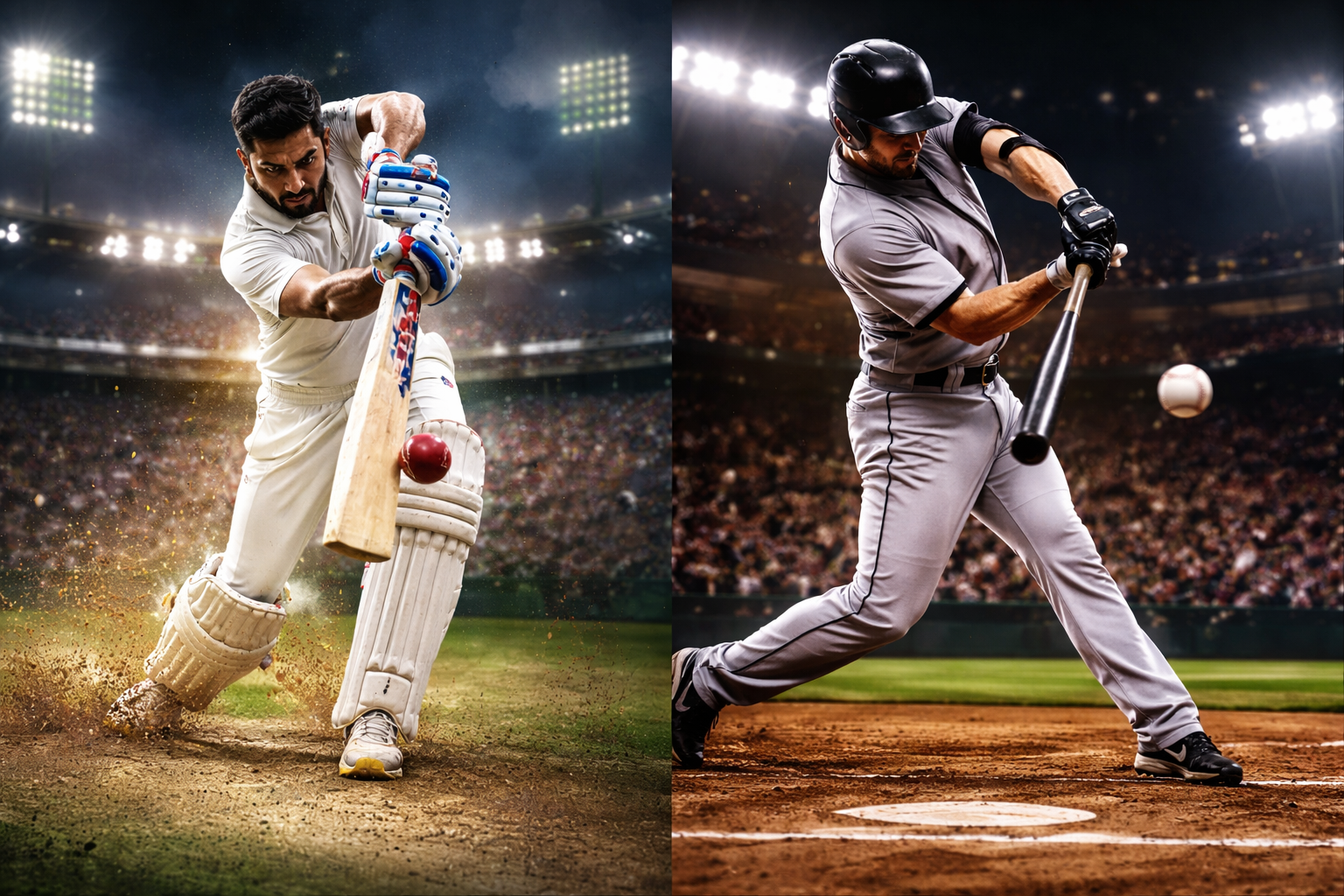
Batter: T20 cricket is becoming baseball in many ways, especially considering that almost every player today is trying to hit every ball. That is the brief for most batters now: hit.
Interestingly, it is not just the hitting that resembles baseball, but also the timing. In fact, timing may be even more important in cricket because the ball is coming off the pitch and not directly through the air as in baseball.
Throwing while fielding: This is where cricket strongly matches baseball pitching.
Not everybody in cricket can throw with intensity. If you watch any professional match around the world, you can immediately spot players with what cricketers call a “good arm.” These are players capable of throwing the cricket ball directly from the boundary into the wicketkeeper’s gloves from distances ranging anywhere between 50 to 80 meters. That is a long and difficult throw.
Note: Best cricket players and legends do not feature in this list just for your information. So it’s a not a cricket talent and instead it’s an anatomical talent.
Keeping this background in mind, let’s see how the unique anatomies developed in these sports can help athletes build alternative careers.
Pitcher: With injuries prevailing among baseball pitchers worldwide, the sport, or perhaps its sports science departments, still do not seem to have answers to safeguard the pitcher long term. At least that is what the rising injury rates suggest. Injuries are increasing with time, not decreasing, despite major advances in sports science.
Cricket throwing is very similar anatomically to pitching. The throwing movement (& range of motion), the muscles and joints involved, the power in the action, and the nuances of strength are all the same.
If you watch cricket videos closely, you can easily identify players who can throw the ball with exceptional pace and force from the boundary, exactly as described above. These cricket players can easily become pitchers and, with the right coaching and sport specific training, it is not difficult for them to transition from cricket to baseball.
Scientifically and anatomically, it doesn’t require any research. It is as clear and sound as it gets.
Batter: Both sports require elite timing and explosive hitting ability. A hard-hitting cricket batter is usually already blessed with timing, which makes adaptation easier from both sides. Their hitting will inadvertently be more powerful in baseball since the ball is coming straight at them and not off the wicket with unknown variation both from the bowler as well as off the deck.
Note on Past Attempts: I know a few players from different sports may have attempted the crossover in the past and failed. However, without proper training that specifically works on the subtle anatomical nuances including joint mobility, kinetic chain efficiency, trunk rotation power, deceleration mechanics, and sport-specific load management – any transition is likely to be fruitless. Anatomy provides the hardware; targeted, expert-guided coaching provides the software. With the right approach, these barriers can be overcome, opening genuine pathways for elite athletes in both directions.
If anybody is interested in conducting a 3 to 4 week camp or study to prove this hypothesis, I would genuinely love to do it.

