
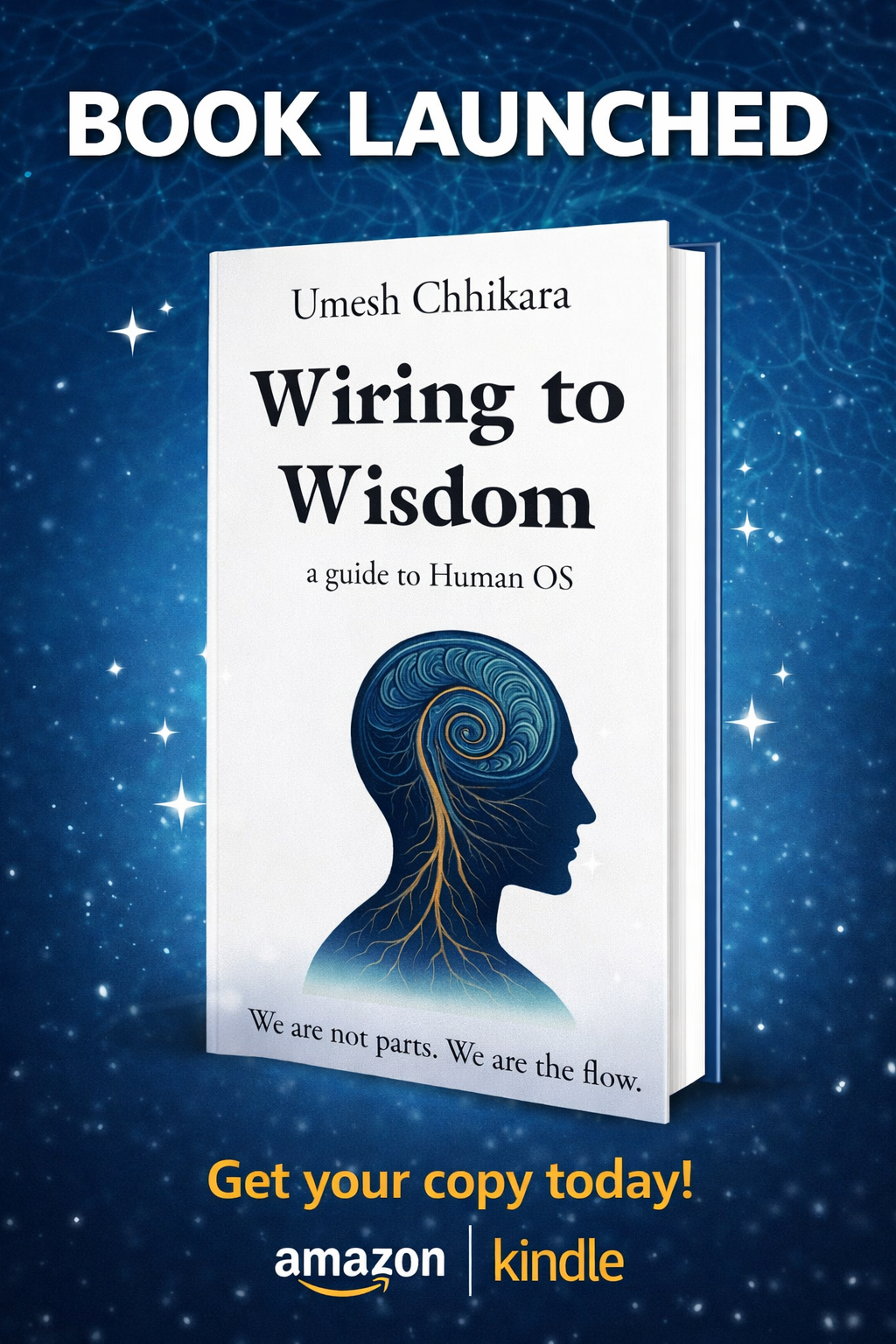
I’m pleased to announce the international release of my book,
“Wiring to Wisdom – A Guide to Human OS.”
The book is now available worldwide on Amazon.
About the book:
While every chapter plays an integral role, if I had to choose one that best captures the essence of the book and helps you decide whether it’s for you, it would be the chapter on page 211 — “From Wiring to Wisdom.”
I’m sharing this chapter below to give you a glimpse into the core ideas and insights explored in the book.
Chapter: From Wiring to Wisdom
If the chapters of this book have woven a single thread through your awareness, let it be this: within you resides a deep, inherent wisdom. This is not a metaphor for willpower or a philosophical abstraction. It is a tangible, biological intelligence, a resilience wired into the very fabric of your being.
Your body is an epic, written in the language of life itself. It is engineered not to fail, but to persist. From the molecular choreography within a cell to the symphony of your organ systems, countless processes collaborate to keep you alive, adaptive, and progressing. Yet, despite this extraordinary innate design, we find ourselves in a quiet struggle with our own health. The flaw lies not in the body’s blueprint, but in our modern departure from understanding it.
This wisdom is literal. It is the accumulated legacy of millions of years of survival, adaptation, and refinement etched into your biology. Every cell knows how to sense stress, conserve energy, repair damage, and negotiate balance. Your heart modulates its rhythm without a conscious command. Your immune system identifies and marshals defenses against threats you may never perceive. Your muscles strengthen precisely where demand is placed; your hormones ebb and flow in rhythms intended to protect, not punish. None of this requires your belief, your motivation, or your discipline. It unfolds because the system itself is intelligent.
This intelligence is inherently resilient. Cells adapt to load. Tissues remodel to demand. Entire systems recalibrate when given the right conditions. Injury mends, strength returns, metabolism adjusts, and equilibrium can be restored – not solely through force of will, but because resilience is the foundational code of your biology.
So why do we falter? The problem is not a lack of internal wisdom, but a world that consistently overrides it. The constant static of chronic stress, fragmented sleep, processed foods, artificial schedules, and fear-based narratives drowns out the body’s subtle signals. When we stop listening and start habitually overriding pushing through exhaustion, ignoring hunger, silencing discomfort with shortcuts, this innate intelligence can seem lost. In truth, it is not broken; it is buried.
Therefore, the ultimate purpose of studying the body is not to dominate it, but to collaborate with it. When you remove unnecessary interference and provide the essential conditions like movement, rest, nutrition, and recovery, the body intuitively performs the functions it has always known. This is the central truth towards which every page of this book has pointed: you are not fragile by design. You are not inherently dependent on external correction. Within you exists a profound and self-aware system that, when respected, knows precisely how to heal, adapt, and endure.
The Shortcut Paradox
In our search for a health mantra, we have too often traded curiosity for convenience. Supplements, protocols, and medications become enticing shortcuts, promising that a pill or a powder can make a problem vanish. We rarely pause to ask the pivotal question: did the system ever need that kind of fixing, or did it simply need to be understood?
What if we suspended that search for a moment? What if, instead of asking what to add, we first asked how the system works? True health emerges at this very intersection by understanding our biological wiring and developing the practical wisdom to honor it.
Movement is not merely about building muscle or counting miles. It is the art of moving the body in accordance with its architectural genius. The shoulder, for instance, is designed both to carry great loads and to retract fully behind the torso in a gesture of release. Many call this flexibility; I call it an anatomical birthright.
Endurance is not the pursuit of a medal for external validation. Before celebrating a long run, learn to decipher the body’s signals. Are you running from a place of integrated balance, or on a foundation of fatigue masked by motivation? Are recurring “niggles” being ignored in the chase for a psychological high?
Nutrition transcends meeting nutrient targets on paper. You can consume adequate vitamins and minerals on a chart and still manifest deficiencies if digestion, absorption, or cellular utilization is compromised. Before layering on supplements, we must examine the foundation. A profound question guides us: Is a low Vitamin D level causing sickness, or is sickness creating the low level?
Mindfulness is too often reduced to a fixed, isolated window of meditation. Thirty minutes of cultivated calm cannot, alone, rewire neural circuits shaped by hours of constant stimulation. Awareness must seep beyond the cushion and into the grain of daily life, the inputs we consume, the rhythms we keep. This expanded awareness only becomes possible when we understand its biological foundation.
The Intelligence of Nature and Self
Nature operates on a quiet, precise intelligence. Living in North India, with its four distinct seasons, makes this beautifully clear. Winter provides cabbage, cauliflower, and spinach, foods that support immunity and digestion in the cold. Summer brings hydrating lemons, bell peppers, and green beans. These cycles are not accidental; they are environmental dialogues refined over millennia.
Even our cravings follow this innate logic. Craving ghee, jaggery, or gajak during a Delhi winter is not mere indulgence; it is an evolutionary prompt for dense energy and warmth. At a neural level, this involves homeostatic circuits managing hunger and temperature, limbic circuits tied to comfort and memory, and predictive sensory circuits anticipating seasonal patterns. This is not the mind instructing the body; it is the body and brain activating a shared, ancient program. It is holism within a holistic environment.
Throughout this book, we have explored cardiovascular, metabolic, musculoskeletal, and mental systems through this lens of innate wisdom. The question that now naturally arises is: can we extend that recognition of wisdom even further?
Spirituality as Biological Insight
Spirituality is often described as a connection to something greater, an inward journey, or a sense of profound interconnectedness. Yet, stripped of its terminology, it closely resembles what we have been practicing all along: the observant study of the body, the thoughtful understanding of our environment, and the deep respect for our innate biology.
The body learns through experience and signal, not through instruction or ideology. Every system adapts based on repeated patterns of load, demand, and feedback. If fat metabolism is impaired, discipline and willpower cannot simply override it. Eating less or training harder may force a temporary change, but without repairing the underlying mechanism, the body will tenaciously defend its established pattern.
Metabolism is not a rational decision-maker; it is a learned response, a living narrative built over time through hormones, enzymes, mitochondrial behavior, and nervous system signaling. Until these pathways are respectfully restored, effort meets internal resistance, not adaptive cooperation.
The same principle applies to muscle and movement. If muscles behave dysfunctionally due to poor coordination, altered neural input, or compensatory patterns, strength training in isolation does not guarantee functional improvement. A muscle can grow stronger in the gym while overall movement quality, efficiency, and resilience remain unchanged.
The body does not reward effort indiscriminately; it responds to accuracy. When the right signals are provided in the right context, with consistency, function improves. When the signals are misguided or conflicting, the body adapts exactly as it has been trained to – often to our detriment.
“Therefore, understanding your inner system is a spiritual practice, whether we choose to call it that or not.”
Most health issues are not simply puzzles of missing nutrients. They are manifestations of misalignment, disconnects between our inherited wiring and our modern environment, lifestyle, and rhythms. Mindfulness, in its truest sense, follows this same principle: by reducing the noise, the underlying patterns surface. With enough clarity and space, the system often begins to self-correct.
If our ancestors thrived on certain whole foods like grains, dairy, or saturated fats, the pressing question is not whether these foods are inherently good or evil. The real question is: what else has changed? We move less, stress more, sleep poorly, snack constantly, and consume foods altered beyond recognition. Without accounting for this total shift in context, nutrition debates are futile exercises in abstraction.
Perhaps spirituality was never an esoteric addition to life. It may have been humanity’s original survival skill. Before advanced diagnostics, humans sensed imbalance. Before nutrition science, hunger, fatigue, and vitality were direct feedback systems to be heeded. What we now call spiritual reflection may once have been a critical biological tool: a heightened awareness to detect disharmony and instinctively adjust behavior.
The essence of all this is elegant in its simplicity: To be healthy is to understand your wiring.
To understand your wiring is to engage in a reflective conversation with your-self, your environment, and your ancestry across all four pillars of being.
This is the journey from wiring to wisdom. It does not ask you to add something new to your life, but to remember something very old within yourself.
“Spirituality is not mystical. It is the highest expression of biological intelligence. It is the system becoming aware of itself.”
 Umesh Chhikara