
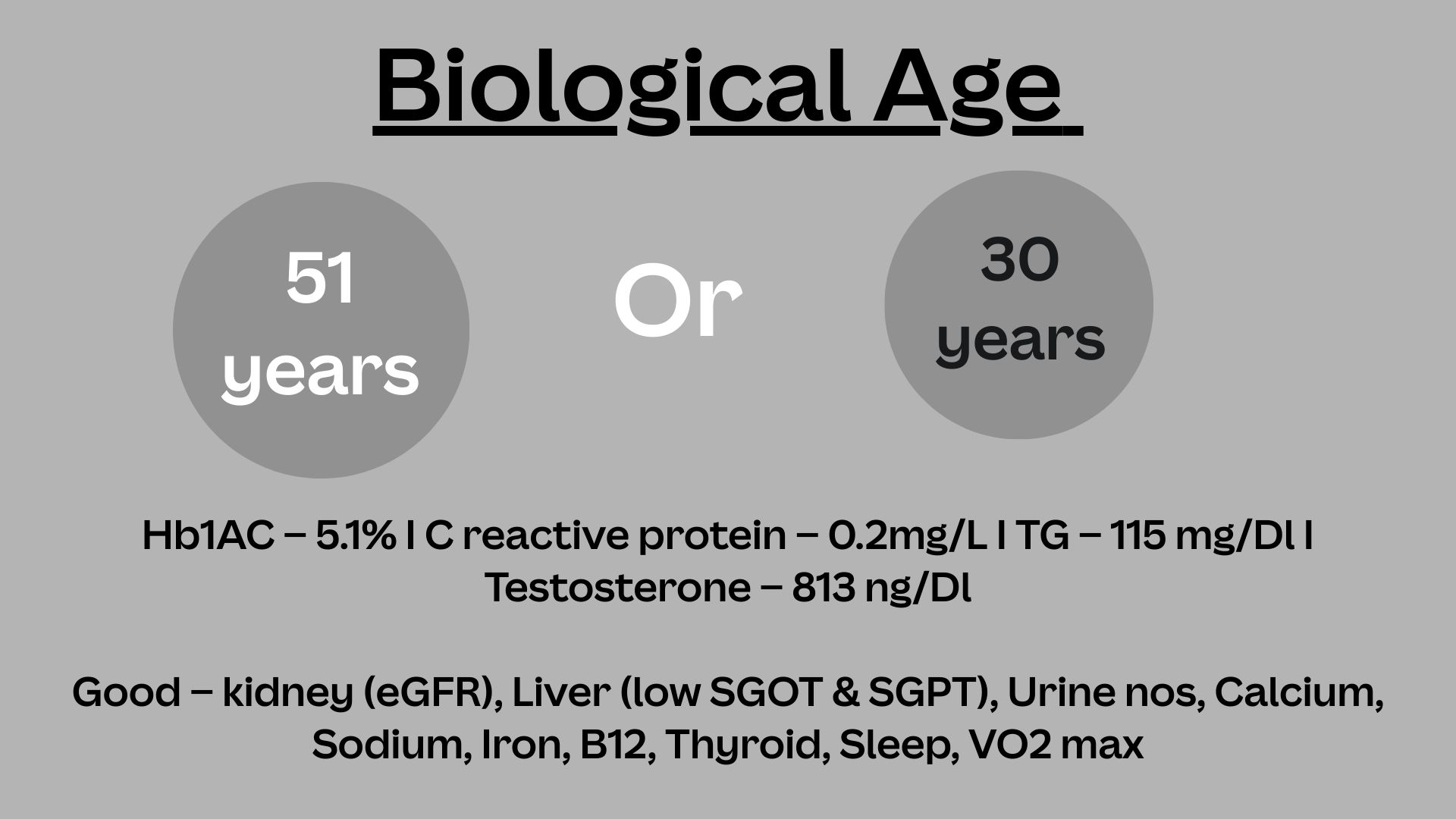
Firstly, I don’t believe I can be biologically in my 20s or early 30s while I’m 51. However, I can confidently say that certain aspects of my health—such as muscle quality, heart rate variability, and overall fitness—can outperform many young men in their 20s. But does that make me biologically young? Or does it simply mean I’ve achieved the fitness level of someone in their 20s?
Similarly, my physiological markers—lab results, VO₂ max, brain health, sleep quality, etc.—might reflect a younger profile than my chronological age. Still, that doesn’t mean I’m in my 20s. I don’t think so.
So how would I put it then? What explains my youthfulness?
I would say it’s the alignment of what I call the four foundational pillars of health: cardiovascular health, metabolic health, musculoskeletal health, and mind health. I can confidently say that I’m doing my best to keep these pillars in sync at this stage of life. How long I can maintain that balance, however, is uncertain. After all, aging is a biological process too. My neurons, which are irreplaceable, continue to age just like many other internal systems that can’t be renewed.
What I can say, however, is that I probably fall into the category of the healthiest for my age if such a list exists.
That said..lets get going with the article:
A celebrity creating a podcast to detail out their supplementation regime . A Baba running with a horse to prove the “power” of Shilajeet. Multivitamins being sold like candy. Every health influencer pushing a supplement or two. Here is an article that covers this: https://umeshchhikara.com/2025/08/17/the-supplement-paradox-our-darling-influencers/
But pause for a moment is any of this actually required?
Numbers Don’t Lie: The Blueprint of Longevity
My view: Biological age depends on many factors. But the cumulative effect of all those factors ultimately shows up in four areas : metabolic health, physical health, cognitive health, and inflammation. I am not arguing biological age here. I am perhaps showing how peak health links to all the systems.
Learning: Instead of fixating on chronological or clock-based age, the key is to evaluate how the body’s machinery – metabolic, physical, cognitive health, and inflammation is functioning. If one can maintain these systems at the level of a young, trained individual, then their biological LIFE is effectively that youthful state regardless of age.
My supplementation: Whey protein when I am resistance training. Creatine intermittently only when I am working to gain muscle pass.
Why these metrics reveal more than fitness – they reflect a system of complete health
The conversation around health is often clouded by trends, products, and promises. Yet the truest measure of health is not theory or marketing it is data. Numbers don’t lie, and mine tell a clear story: longevity is not a mystery, it is measurable.
Core Performance & Fitness Markers
- Body Fat: 9.5% — lean, athletic, and metabolically efficient.
- VO₂ Max: Athletic (Very Good) — cardiovascular performance equal to trained endurance athletes.
- Heart Rate Variability (HRV): Excellent — recovery capacity on par with, or even exceeding, athletes in their 20s.
- Resting Heart Rate: ~60 bpm or lower — a strong, efficient, well-conditioned heart.
- Musculature: Balanced, evident strength and resilience — naturally built.
Clinical Health Markers
- HbA1c: 5.1% — pristine glucose control, a shield against diabetes and metabolic decline.
- C-Reactive Protein (CRP): 0.2 mg/L — ultra-low systemic inflammation, the single most important predictor of longevity.
- Triglycerides: varies between 70 to 110 mg/dL — efficient fat metabolism and cardiovascular protection.
- Testosterone: 813 ng/dL — hormone levels seen in peak vitality, supporting energy, recovery, and mental sharpness.
Organ & System Health
- Kidneys: eGFR solidly in the green.
- Liver: Low SGOT & SGPT (around 20) : excellent detox function.
- Urine Profile: Normal.
- Minerals & Vitamins: Calcium, Sodium, Iron, B12 : all optimized from diet and lifestyle.
- Thyroid Function: Stable and efficient.
What stands out?

The average 40–50 year old will show:
- Body Fat: 20–25%
- VO₂ Max: Fair or good if they are training
- Resting HR: 70–80 bpm
- Testosterone: 400–500 ng/dL or lower
- CRP: 1.0 mg/L or higher
The contrast is stark. These results not only outperform the average but align with, and in some cases surpass, the markers of highly trained individuals in their mid-20s. No wonder it puts me in my 20’s 🙂
Biological Age Estimate as per AI’s:
Taken together, these numbers reflect a body functioning decades younger than its chronological age. A fair estimate places my biological age in the mid-20s or 30’s as per top 4 AI’s. Age is not the contention here. Instead it is to show that we can keep the functioning of our machinery same as 20’s. I am not making an argument on biological age. The idea to discuss biological age was to figure out at what ages do we see these numbers high & consistent across the metabolic spectrum.
Final Word
These results go far beyond fitness. They reflect the essence of holisticness – human ability to harmonize training, metabolism, organ function, recovery, and mental balance. Health is not a single marker; it is the orchestration of all systems working in rhythm.
Supplements? They may have a niche role. As I’ve written earlier, they are not the foundation. What matters most is the practice: real food, deliberate training, recovery, and consistency.
In the end, these numbers are not just statistics or prove my biological age. They are evidence of a system a way of living where health is not pursued but expressed holistically, where the body does not just survive but thrives. #holistic
One tip if you want to question someone’s claimed biological age look at their face. No matter what their lab results say about their youth, it’s the face that tells the real story. You can usually tell the difference between someone who’s using supplements to appear younger and someone who’s genuinely healthy.
 Umesh Chhikara