
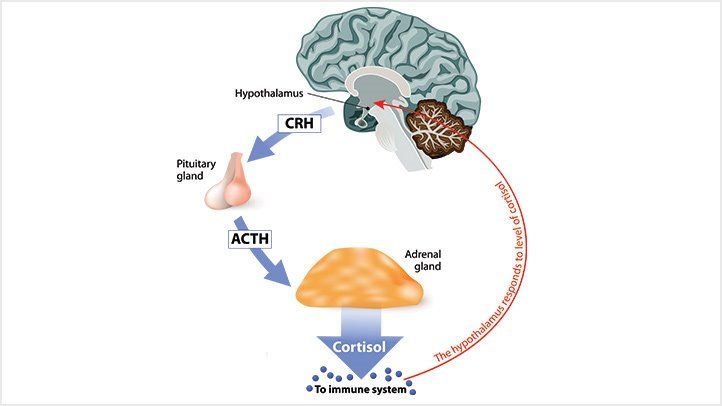
Why chronic thinkers struggle with weight (cortisol → fat storage)?
Why action-takers stay lean (dopamine → energy expenditure)?
🔬 A FUNCTIONAL STRESS MODEL
“Dopamine as the Axis, Cortisol as the Amplifier”
🔹 Stress Can Be Subdivided:
1. Physically-Oriented Stress (Action-Oriented) – Dopamine driven
- Examples: Exercise, performance, physical risk, lifting, sprinting — fight-or-flight mode.
- Outcome: Dopamine surge + acute cortisol (Dopamine-dominant response).
- Effects:
- Appetite suppressed (GI function slows; blood diverted to muscles).
- Clarity increases (heightened senses, no cholinergic interference).
- Hormesis (positive adaptation to stress).
- 🧠 Why? The body prioritizes action: energy is mobilized (not stored), and digestion is deprioritized.
2. Thought-Oriented Stress (Cortisol-Dominant) – Cortisol driven
- Examples: Worrying about grades, social interactions, hypotheticals, office/home stress, arguments.
- Outcome: Cortisol builds + dopamine (Cortisol-dominant response).
- Effects:
- Hunger increases (Cortisol → spikes cholinergic activity, dulling senses and triggering “conservation mode”).
- Emotional eating (brain seeks dopamine spikes via comfort food).
- Fatigue + fat deposition (High cortisol → “Addis fat” storage, especially visceral fat).
- 🧠 Why? Chronic mental stress traps the body in a low-grade sympathetic state:
- Cortisol disrupts energy balance, mimicking famine signals → craving high-calorie foods.
- Low dopamine exacerbates rumination, reducing motivation to move (energy remains unspent).
🎯 Dopamine: The Master Modulator
Dopamine’s interaction with cortisol dictates stress outcomes:
| Dopamine State | Cortisol Level | Dominance Type | Result |
|---|---|---|---|
| ↑ High | ↑ Low | Excitement/Challenge | Alert, no hunger |
| ↑ High | ↑ High | Action-Focused Stress | Laser focus, no hunger |
| ↓ Low | ↑ High | Rumination/Worry | Anxiety, hunger, fat storage |
| ↓ Low | ↑↑ Very High | Helplessness/Overwhelm | Cravings, fatigue, Addis fat gain |
🧠 Final Insight: The Stress-Fat Connection
- Cortisol’s Fat Trap:
- Triggers cholinergic overactivity → dulled satiety signals + “fraudulent hunger” (even with adequate calories).
- Promotes visceral fat deposition (Addis fat) as an evolutionary response to perceived scarcity.
- Dopamine’s Role:
- Low dopamine + high cortisol = seeking quick rewards (food) → cyclical overeating.
- High dopamine + cortisol = stress fuels action, not storage.
Bottom Line:
Thought-oriented stress (cortisol-dominant) hijacks metabolism: ↑ hunger, ↑ cravings, ↑ fat storage.
Action-oriented stress (dopamine-dominant) suppresses hunger and burns energy.
Q: Can we intentionally switch from one state of mind to another?
Absolutely. With practice, we can train ourselves to do this. In fact, the key to understanding spirituality and the mind lies in this very ability. If we make persistent and conscious efforts, we can master the art of controlling our mental and emotional states.
Our emotions are natural—anger, sadness, and frustration will arise. But we don’t have to remain stuck in them. The ability to shift out of these states depends on the delicate interplay of hormones like cortisol, dopamine, and serotonin. And where does the control lie? In the mind. Train the mind, and you train your hormones.
 Umesh Chhikara