
Introduction
Any diet regime should consider a critical truth: your metabolism isn’t static—it adapts. When you eat less, your body burns fewer calories to conserve energy. When you eat more, it doesn’t always increase calorie burn proportionally. This leads to frustration, weight regain, and metabolic slowdown.
To understand why, let’s explore two scenarios using flowcharts:
- Healthy Metabolism – Energy in matches energy out. And ‘energy in’ is ad libitum.
- Dysregulated Metabolism – Diets disrupt balance, leading to fat storage.
1. Healthy Metabolic Regulation (Balanced Energy)
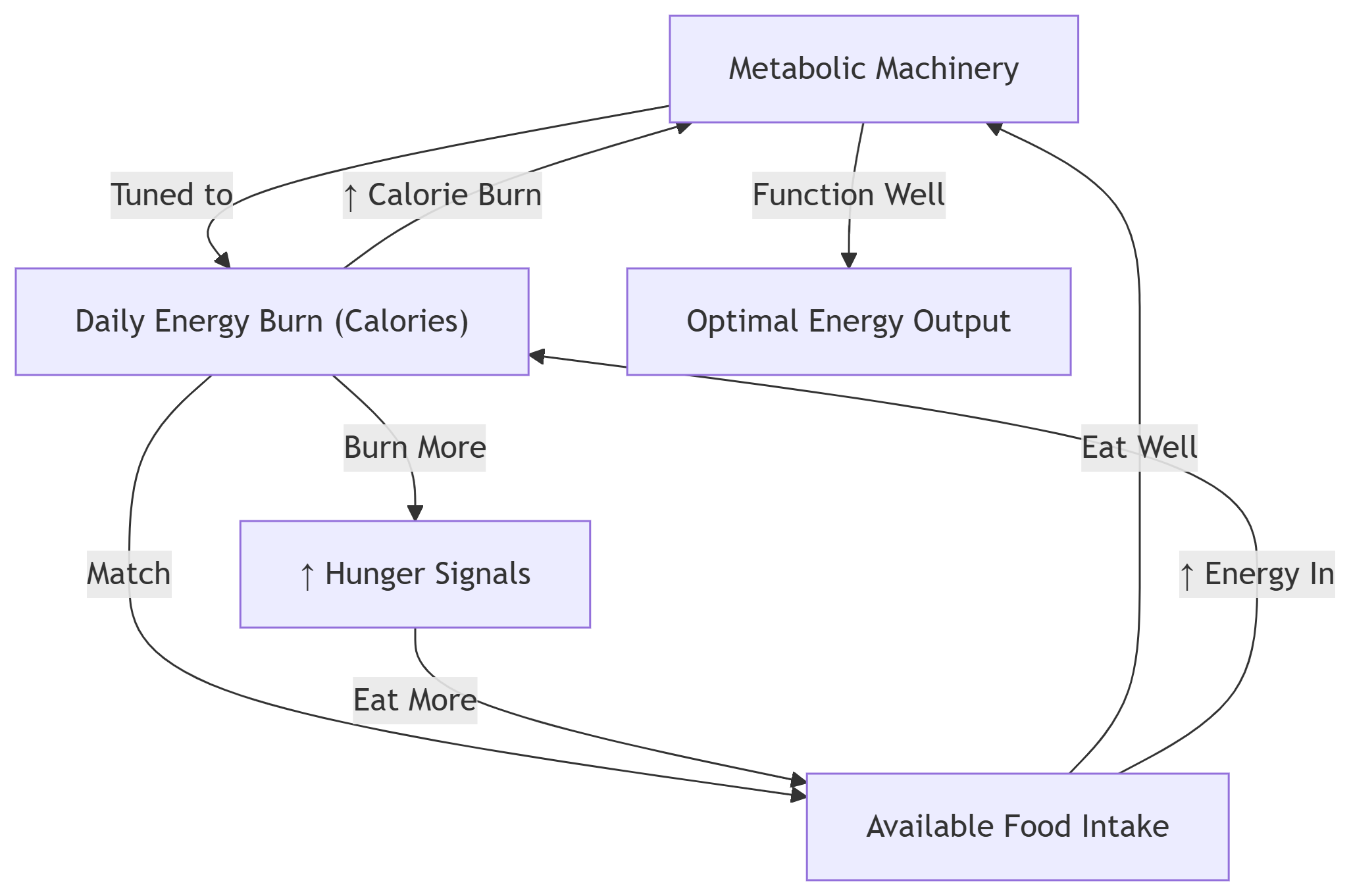
Key Takeaways:
✅ Energy Balance – Your metabolism adjusts hunger and burn rate to match food intake.
✅ Adaptive Calorie Burn – If you exercise more, hunger increases to replenish energy.
✅ Stable Weight – Eating more → burns more; eating less → burns less (no drastic fat changes).
Example: When you start walking 10,000 steps daily, your body naturally increases hunger to offset the extra burn, keeping weight stable. If we do not match the ‘calories in’ with ‘calories out’; we will lose weight initially before our metabolism starts matching for new calories intake with calories out. We stop losing weight and plateu.
2. Broken Metabolic Regulation (Why Diets Fail)
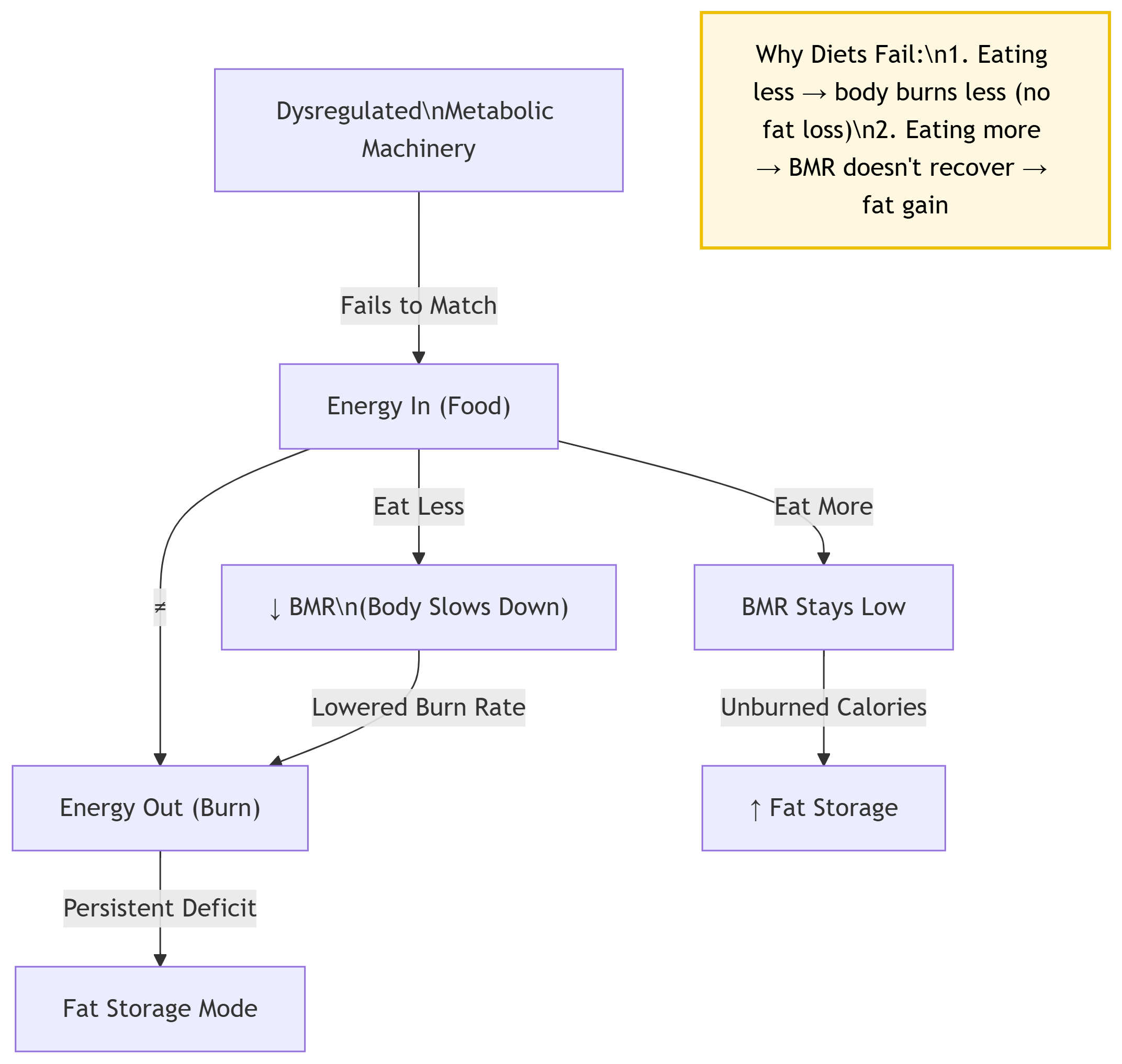
Key Takeaways:
❌ Metabolic Slowdown – Eating less – cells reduce metabolic rate → body burns fewer calories (↓BMR).
❌ Mismatch in Energy – If you restrict food but BMR drops, you stop losing fat.
(Exercises and NEAT work can directly work on keeping the same BMR or increase it in which case we lose weight. )
❌ Overshooting Fat Storage – When you eat more again, BMR doesn’t recover quickly → excess calories stored as fat.
Example: After a strict diet, eating “normally” leads to rapid weight regain because metabolism is still slowed. #thebiggestloserstudy
Why This Happens: Evolutionary Survival Mechanisms
Your body doesn’t care about looking lean—it cares about surviving. When you:
- Undereat → It conserves energy (slows thyroid, reduces NEAT*).
- Overeat → It prioritizes fat storage (because it expects future scarcity).
(NEAT = Non-Exercise Activity Thermogenesis)
How to Fix a Broken Metabolism
- Avoid Extreme Deficits : Do not cut calories below BMR. The best measure for this is eating to fullness (ad libitum) if you are eating home cooked food. If you are not losing weight then the problem is somewhere else as is explained in the above model.
- Find a way to increase BMR: Exercising or movement together with the right type of food and timing can help us increase our calories matching with the burn. (Study: https://umeshchhikara.com/2025/03/15/increased-cals-reduced-fat-study/)
- Lose Fat & Increase Lean Mass: This will help increase the BMR. More lean tissue, more burn.
Conclusion
- Diets fail because they ignore metabolic adaptation.
- Healthy metabolism balances intake and burn.
- Crash diets break this balance, leading to weight cycling.
Solution: Eat at maintenance calories, prioritize strength training to preserve muscle mass, and allow your metabolism to stabilize. Your BMR adapts gradually—drastic, sustained calorie deficits or surpluses are required to significantly disrupt equilibrium.
1. Constrained Energy Model & Metabolic Adaptation
- Pontzer et al. (2015) – “Constrained Total Energy Expenditure and Metabolic Adaptation to Physical Activity”
- DOI: 10.1126/science.aaa5504
- Shows that increased physical activity doesn’t linearly increase energy expenditure due to metabolic compensation.
- Speakman & Westerterp (2013) – “Associations between energy demands, physical activity, and body composition in adult humans”
- DOI: 10.3945/ajcn.112.051391
- Discusses how the body adapts to energy deficits by reducing non-essential functions.
2. Metabolic Adaptation in Weight Loss (Energy Deficit)
- Rosenbaum & Leibel (2010) – “Adaptive thermogenesis in humans”
- DOI: 10.1038/ijo.2010.184
- Explains how the body reduces energy expenditure (adaptive thermogenesis) during calorie restriction.
- The Biggest Loser Study (2016) – “Persistent metabolic adaptation 6 years after The Biggest Loser competition”
- DOI: 10.1002/oby.21538
- Shows long-term metabolic slowdown after extreme weight loss.
3. Energy Partitioning & Refeeding (Energy Surplus)
- Dulloo et al. (2015) – “How dieting makes the lean fatter: from a perspective of body composition autoregulation”
- DOI: 10.1017/S002966511500022X
- Explains why dieting often leads to fat overshooting when returning to normal eating.
- Müller et al. (2018) – “Metabolic adaptation to caloric restriction and subsequent refeeding: the Minnesota Starvation Experiment revisited”
- DOI: 10.3945/ajcn.117.155259
- Reanalysis of the classic Minnesota Starvation Experiment, showing metabolic suppression and fat regain.
4. Energy Distribution & Biological Trade-offs
- Halsey et al. (2018) – “The interactions between exercise, metabolic regulation, and the microbiome”
- DOI: 10.1016/j.tem.2018.01.008
- Discusses how energy is allocated between different physiological systems under stress.
- Westerterp (2017) – “Exercise, energy balance, and body composition”
- DOI: 10.1007/s00421-017-3737-3
- Examines how exercise affects energy partitioning between fat and muscle.
 Umesh Chhikara